
This week, the book of James was calling my name. Have you ever said something and wished with all your heart that you could reel it back in and erase the memory of your words in the minds of everyone who heard what you said? 


I am, sadly, an expert in this field. The book of James –in its original Greek version-- was addressed, “Dear Paula….”


The funny part is that even as I’m speaking something crazy, I know the words coming out of my mouth are just wrong. And then I start digging an even bigger hole, trying to explain whatever train of thought left the station without an engineer on board.


All of us do this occasionally. And we’ve been on the other side of it, too.


Many years ago, during an employee review, an employee kind of lost it and shouted, “Any moron would know that I should not be doing the filing”. Of course, I was the moron in question. And the one signing the paycheck. I know that employee wished those words could be reeled back in…or that the Harry Potter spell OBLIVIATE would erase my memory.


Regardless of why those moments happen, or what we say, or what is said to us,  words carry meaning. James is saying, ‘When you are speaking as a leader, a teacher, a preacher, a parent, an official, anyone in a place of perceived authority, your words --and their meaning-- are amplified…for better or for worse.


Most of the time, we are consciously thoughtful about what we are saying and the audience to whom we are speaking. But we are not perfect. 


Last week, I participated in a study of this text. After we read the version printed in today’s bulletin, one person asked, “Where is the grace in this?”


And then we read the same Scripture as interpreted in The Message.

"Don’t be in any rush to become a teacher, my friends. Teaching is highly responsible work. Teachers are held to the strictest standards. And none of us is perfectly qualified. We get it wrong nearly every time we open our mouths."


None of us is perfectly qualified.


All of us are in need of grace.


We have entered a challenging time in our nation—a presidential election season.  Advertisements and memes and podcasts fill our TVs, ipads, radio stations, and cell phones. While I was writing this sermon on Friday, I had four political phone calls—in the span of 8 hours. It will be relentless until it is over.


And here’s some good news:  it will be over in 50+ days.


During that time, James is whispering into our ears: You are followers of Jesus. Your words…your actions…carry meaning…and that meaning will be amplified because you are followers of the way.


We have a distinct opportunity to set ourselves apart from the rancor of this moment, and to refocus our energy on the Kingdom of God on Earth.


We can turn off the television and volunteer at the West Side Food pantry or Southwest Food pantry. We can choose to not engage with Facebook posts and instead spend time helping low-income families do their laundry next Saturday at Laundry Love. We can choose to go visit a friend, or call someone who’s alone. We can ride with Ben and deliver Meals on Wheels.


We can choose to have our words and our actions carry meaning that points toward the Risen Christ. It is, in my opinion, the most authentic form of evangelism….no door knocking required. Together, we can be that Light in our community, in our families, and in our friendships.


A few days after my staff member’s evaluation, I received a request to sit down together and talk. I really didn’t want to sit down with someone who had erupted in a tirade and called me names. My administrative assistant, who knows me well, said, “You will do this.” [Me:] “NO I WON’T” “Yes you will…because you need to forgive her and she needs to experience that kind of grace.”


We did meet; and our relationship as both friend and colleague was restored.   


None of us are perfectly qualified.  All of us are in need of grace.


James asks: Does a spring pour forth from the same opening both fresh and brackish water?  Or does a fig tree produce olives? The answer, of course, is no.


We cannot profess to be followers of Jesus and immerse ourselves exclusively in the divisive political ways of our time. 


He is challenging us to live, speak, and act in ways that reflect and amplify the Love and grace of Christ in us. He is challenging us to participate in the Kingdom of God on earth.


And here’s some good news:  This is a kingdom will not be over in 50 days or so. God’s kingdom is eternal.


Amen.


By Paula Jefferson July 26, 2026
By Melanie Kingsbury May 17, 2026
By Paula Jefferson May 10, 2026
By Paula Jefferson May 3, 2026
April 12, 2026
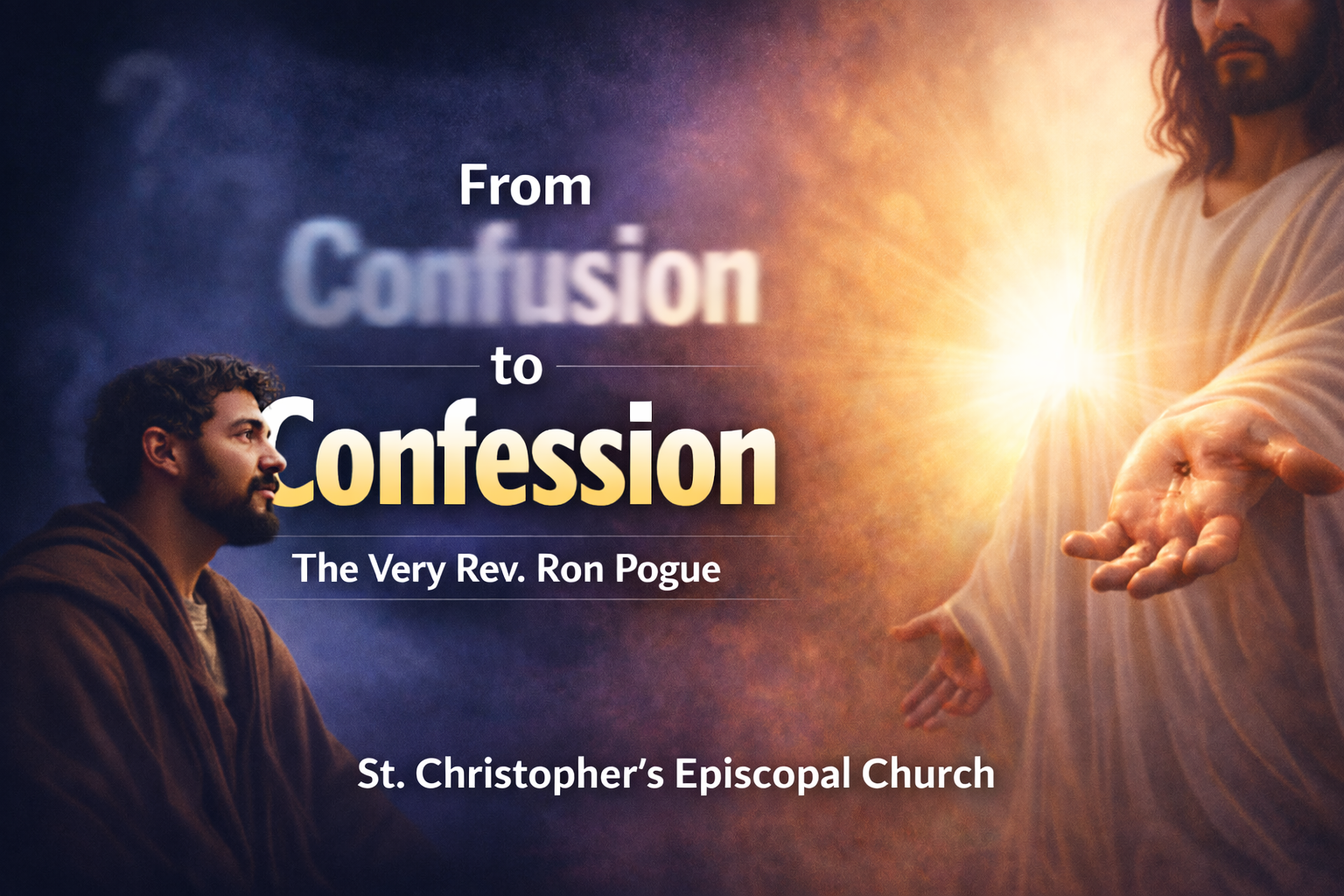
Once when a certain preacher launched into a children’s sermon, she was confronted by a visiting child, an eight-year-old friend of a regular member. The boy was new to this church but was a regular attendee at another congregation that did not have children’s sermons. Nevertheless, the visitor tried his best to follow the line of the preacher’s effort to connect with the children. Attempting to hook the children with something familiar before making her point, the priest asked the children to identify what she would describe. “What is fuzzy and has a long tail?” No response. “What has big teeth and climbs in trees?” Still no response. After she asked, “What jumps around a lot and gathers nuts and hides them?” the visiting boy could stand the silence no longer. He blurted out, “Look, lady, I know the answer is supposed to be ‘Jesus,’ but it sure sounds like a squirrel to me.” Today’s Gospel reveals to us St. Thomas – who was put in a situation similar to that of the boy at the children’s sermon. Thomas was the one who had not seen the risen Jesus when he first appeared to the disciples. The others told him they had seen the Lord, but he was skeptical. He doubted. Still, Thomas must have wanted to fit in. He might have said, “Look, friends, I know the answer is supposed to be that I acknowledge that you saw Jesus, but it sure sounds like a ghost to me.” Aren't we all a little like Thomas? Thank God for that! Because, as Elton Trueblood once said, “a faith that is never questioned isn't worth having.” Thomas remained with the others until his doubts and uncertainties were transformed into a dynamic faith. Doubt is a universal human experience. We have all felt the pain, the harassment, and the threat of it. Doubt comes in different depths. The deepest form denies that we can believe anything at all. The other extreme is the mind of the dogmatic that sails along with unquestioning confidence on a sea of tranquil certitude. While there is a certain appeal in dogmatic tranquility, there is also the danger that we might overlook the possibility of error in our most familiar beliefs. As much as we might like to think of eliminating any trace of doubt in our life, the truth is that it would be undesirable, even if it were possible. When someone tells me that he has never had a moment of probing religious doubt, I find myself wondering whether that person has ever known a moment of vital religious conviction. For if one fact stands out above all others in the history of religion, it is this: the price of a great faith is a great and continuous struggle to get it, to keep it, and to share it. Faith is a fight as well as a peace. I find myself thinking of my task as a Pastor and Teacher in the way described by Paul Tillich, when he said, “Sometimes I think my mission is to bring faith to the faithless and doubt to the faithful.” Tuesday of this week is the annual remembrance of the Holocaust, Yom Hashoah. As we recall that tragic chapter in human history, we are painfully reminded of Adolf Hitler. Hitler was an atheist. We usually think of atheism as ultimate doubt. But when you think of it as a religion, you can see how helpful it would be to have a system of doubt to correct it. Hitler had no religion to cast doubts on his approach to life. But there are other problems besides Hitler's form of atheism. There is, for example, practical atheism. Practical atheists believe in God. He just doesn't have anything to do with their lives. Martin Luther once wrote, “There is the person who has never doubted that God is, but who lives as though God were not; and there is the person who doubts whether God is, or even denies that God is, but lives as though God were. In the latter, the grace of God is at work.” Look at the lives of the saints. According to holy legend, doubt appears as a temptation which increases in power with the increase of saintliness. In those who rest on their unshakable faith, pharisaism, fundamentalism, and fanaticism are the unmistakable symptoms of doubt which has been repressed. Doubt is overcome not by repression but by courage. Courage does not deny that there is doubt, but it takes the doubt into itself as an expression of its own finitude and affirms the content of an ultimate concern – a concern that impacts our lives and how we relate to the world around us and the people in it. Courage does not need the safety of unquestionable conviction. It includes the risk without which no creative life is possible. The Christian faith is stronger than our doubts. It is like the Chinese proverb, which says, “Chinese sails, though full of holes, still work.” Suppose a half dozen of us were seated around the walls of a darkened room. We are told that somewhere in the open, middle space, there is a chair. It is not just any chair; it is an antique, the creation of a noted designer, worth several thousand dollars. Which of us will find that chair? Certainly not those who sit still and philosophize about where the chair might be placed, about its existence, or about its value. No, the chair can be found only by those who have the courage to get up and risk stumbling around in the dark, using whatever powers of reason and sensation we might have until the chair is discovered. Or in our relationships with those we love. I have faith that my wife loves me. I feel her kindness, her caring, her loving touch - all these I interpret to mean that she loves me. Not every moment of our relationship has been perfectly romantic. We went to high school together and during that time I thought she hated me. I was wrong; she was just shy. But I came to see that her acts of love are such that, while I cannot claim absolute certainty now or about the future, I have a deep faith in her love for me. We cannot ever “know” or “verify” the experience of love with the same probability as sunrise or a lab experiment, but we have faith that love is real, is what we know to be the case, is the explanation which correctly interprets certain “scientific” experience. Those who are familiar with the scientific method know that the point is not to set out to prove a theory but to attempt to disprove it. Doubt is an essential element in the advancement of science, in the pursuit of truth, and in critical thinking. As far as we know, human beings are the only creatures on the planet, perhaps in the cosmos, endowed with the privilege and responsibility to exercise reason. Once a young man said to the philosopher, Blaise Pascal, “Oh that I had your creed, then I would live your life.” Pascal replied, “let me tell you something, young man. If you will live my life, it will not be many days until you have my creed.” In other words, Pascal is saying it is easier to act your way into belief than the other way around. And when we see Thomas after the resurrection, we follow the trajectory of his faith from confusion to confession. The risen Christ, at last, confronted him in the presence of the others and together they dealt with his doubt until it gave way to affirmation. He does that for us, too. In an era when many people in power have a view of Christian faith that is very narrow and contained in a very confined context, I am grateful to be in a Church that has room for doubt and is open to questions. Those who come to us with those doubts and questions receive a genuine welcome and are lovingly embraced so that we can journey and grow together in faith, hope, and love. 
By Paula Jefferson April 6, 2026
By Paula Jefferson March 29, 2026
March 22, 2026
By Paula Jefferson March 16, 2026
Show More