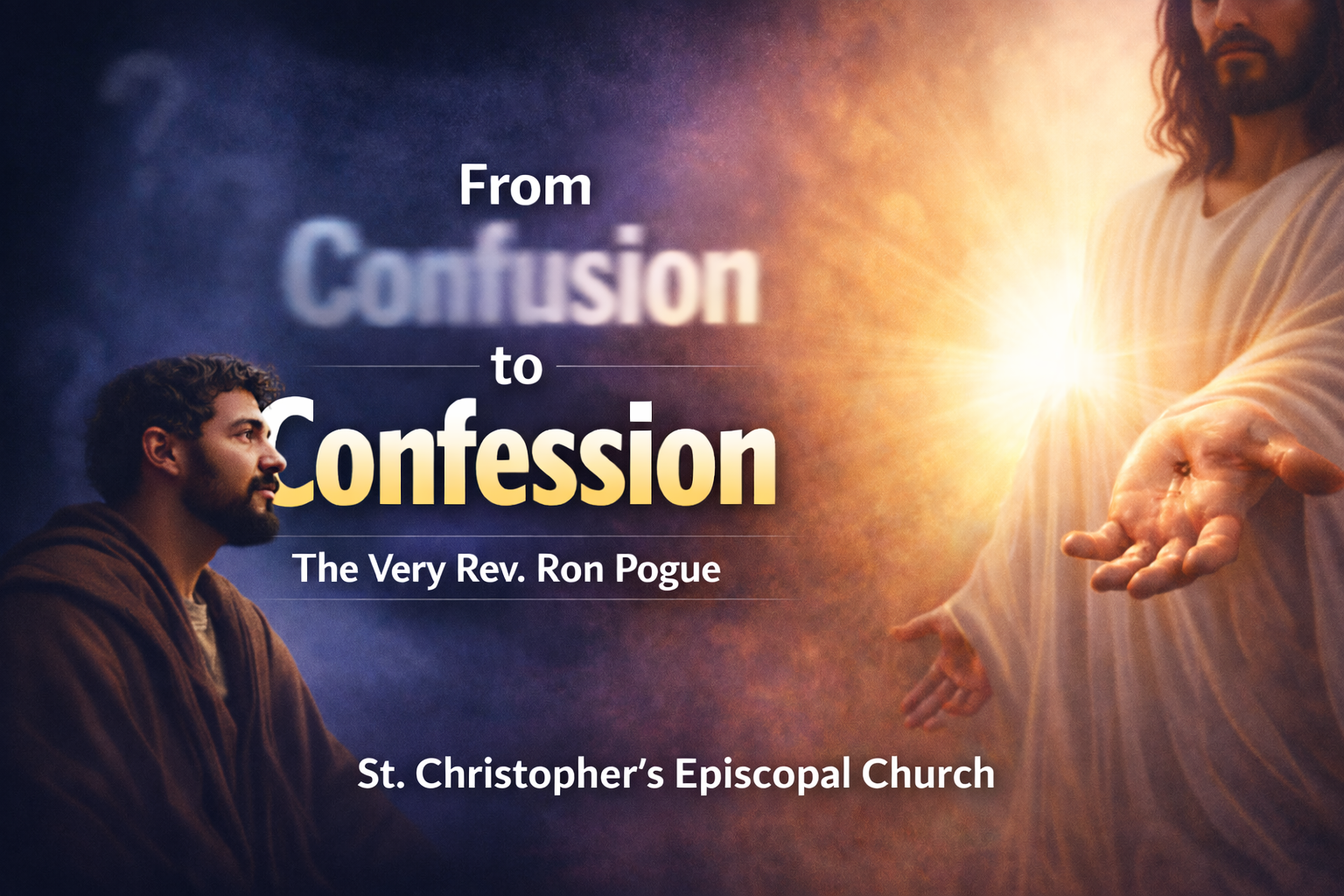

There are two different things that I’m going to talk to you about this morning and the most significant one that I’m going to focus on is St. Christopher himself. Now we know that our church is called St. Christopher but there was a saint whose name was St. Christopher, who also is for whom we have named our church.


And there is a beautiful painting there. That’s called an icon that’s going to be given to our church today and blessed and it is St. Christopher and so we are going to talk about that and we are also going to pull in a little bit from our Gospel story today.


I’m sure for those of you who were listening to the Gospel story. It was a little disturbing. Don’t know if you heard it or not, but you heard there was a woman asking for healing for her daughter and there was some words used about should we give the children’s bread to dogs. And yet the woman said well even the puppies eat the scraps that fall from the master’s table and in that moment, Jesus said to hear, “You have spoken truth.”


Now we don’t know if Jesus changed his mind of if he was simply declaring so that every one around could hear and know that God’s love is bigger than all the lines that we draw. When we say those people are outside, they are outside God’s grace, they are at the edge. This woman was a Canaanite and it just so happens so was Christopher.


So I’m going to pass around some pictures and I want you to look at those Christopher and tell me what you see. What do you see in that picture? What is odd Giovanni? … You see a kid on top of St. Christopher and I’m going to explain who that kid in just a second. Do you see that ya’ll pictures have a dog’s head?


Many icons of St. Christopher actually have a dog’s head for St. Christopher and the reason is because he was a Canaanite and the reason is because it was believed that the Canaanites were beyond, they were outside. They were those people that we really can’t accept. And one of those reason that those icon are painted to help all of us see that God sees it different, that when God looks at people he doesn’t see the other, the outsider, those dog headed people. God sees beloved people who belong to him.


St. Christopher was a Canaanite. He was one of those people. He was huge. He was seven and half tall. He was a massive man. And they say he didn’t look too attractive. He was kind off scary, the big strong warrior and he was working for the Canaanite king and one day he thought I notice that the king trembles when he hears Satan or the devil mentioned so the devil must be more powerful than this king so I’m going to go looking for the devil and serve him. So off St. Christopher to find the devil.


Well, he ran into a group of thieves that called themselves the devil and he says, “I think I found them” so he started working with them and they would rob people. Remember he’s big and he’s strong. Well, one day he noticed that when they passed a cross on the side of the road that the thieves went away from them. They kind of were scared of it. And he went hmmm, well who is this that even the devil is afraid of and so he began a journey to figure out who this cross person was, who this Christ person was.


He found an old hermit who was a Christian and the hermit began to teach him and tell him about the love of God. And in that learning, he became a Christian. He realized that the love God had for him was bigger than all of that outsider business that everyone else talked about it. It was bigger than all of the evil and the darkness. So here is St. Christoher, he’s a big strong tall man and you know they actually called him Reprobus because Reprobus means a reprobate, a reject that’s how he was known. But he said to the hermit, “What must I do to serve Christ?” and the hermit thought, “Well, I fast and I pray every day. Maybe you do that.”


I don’t know if any of you have had big strong tall men in your life but big, strong tall men generally like to eat a little big. And Reprobus said, “I don’t know if I can do that fasting thing.” So the hermit thought with him and I have another idea, There is a river that passes here and back in that time they didn’t have bridges over every river. They didn’t have easy ways to get across the river.  And so people would have to walk through the river and sometimes the river would get high and they would get washed down the river and so the hermit told Reprobus, he said, “You’re big and you’re strong and so when those waters come and they rush you can stand firm.”


And so Reprobus took his place on the side of the river. And when a visitor would come he would hold on to them and hold them steadily across even when the waters got rough and lead them to the other side. And that became his service for Christ.


So here’s where the child comes in. One day Reprobus was standing at his place on the side of the River and a very small child came to him and the child said I need help crossing the river. Reprobus, said No problem. He picks him up puts him on his shoulder and begins to cross through the river and he gets into he river, all of the sudden the child becomes so heavy like lead, like he’s not going to be make it and he struggles and he finally gets all the way across and he sets the child down and he says, “Child, who are you? Why did you become so heavy when I was trying to cross the river” and the child said, “I am the Christ child and I carry the weight of the world.” Christopher said, “How do I know it’s you?” and he said, “Put your staff in the ground and come back tomorrow” and the next day when he came back his staff had sprouted into a palm tree and oftentimes on icons you’ll see and ours has it, too, there are palm fronds at the top. Reprobus knew that that had been the Christ child and from that day forward, he was known as Christopher. The word Christopher means Christ bearer or carrier. Just like the crucifer is the cross carrier.


So that’s where Christoher got his new name. He became a saint in the church and people said I want to be like him because he took all of who he was with his giant stature and strength and he gave it in service to Christ. He became the patron saint of travelers and outsiders and we’ve been called to walk in his footsteps.


I challenge all of us to reflect on who Christopher is and how that affects our call. Who in our community are the dog-headed people that we need to remember that God says my love goes beyond any barriers we draw. And who are the people who are travelers that need help getting the waters of life and the difficulties that might knock that them over and how we can be a Christopher and carry Christ with them out into the world.

Amen.

By Paula Jefferson March 16, 2026
By Paula Jefferson March 8, 2026
In 2017, I visited Jacob's Well. We stood in a circle and read today’s Gospel text. John tells us what happened when the women encountered Jesus. But, as I worked with the text this week, I wondered what the story might sound like if it was told by the woman, rather than a narrator. So imagine, for a moment, that she is the one telling the story. As you listen, notice the conversation is like a chess match—each question invites the conversation to deepen. I did not go to the well that day looking for God. I went because the jar was empty. You know how life is. Morning comes, the sun climbs higher than you expect, and before long the ordinary tasks are piling up: Bread to bake; Water to draw. Work that does not ask what kind of person you are—it simply asks to be done. So I took my jar and walked the familiar road to Jacob’s well. It was the middle of the day. No shade, no breeze. I preferred it that way. If you go early in the morning, everyone is there. The conversations begin before the bucket even touches the water. People talk about crops, about marriages, about children. And sometimes about other people’s lives. My life has been the subject of those conversations. So, I go at noon. Alone. But that day there was a man sitting beside the well. At first, I thought he must be a traveler resting his feet. The dust on his robe said he had come a long way. But when I looked more closely, I saw something else. He was a Judean. Now you have to understand something about that. Judeans and Samaritans do not usually share wells, cups, or conversations. We have our mountain, they have their temple, and between those two places lies a long history of arguments. So I lowered my eyes and went about my work. If I kept quiet, perhaps he would too. But then he spoke. “Give me a drink.” I looked up. Surely, I had misunderstood. “You are a Judean,” I said, “and I am a woman of Samaria. How is it that you ask me for a drink?” He did not apologize. He did not withdraw the request. Instead, he said something even more strange. “If you knew the gift of God,” he said, “and who it is that is saying to you, ‘Give me a drink,’ you would have asked him, and he would have given you living water.” Now I have drawn water from that well since I was a kid. My parents did. My grandparents did. The well is deep, and the water is good, but no one draws it without a rope and a jar. I looked at his empty hands. “Sir, you have no bucket, and the well is deep. Where do you get this living water? Are you greater than our ancestor Jacob, who gave us the well?” He did not laugh at my question. “Everyone who drinks this water will be thirsty again. But those who drink the water I give will never thirst. The water I give will become a spring inside you, giving eternal life.” A spring inside me? That was a bold claim. And if it was true, it would change everything. “Sir, give me this water, so that I may never be thirsty or have to keep coming here to draw water.” Then he did something unexpected. He said, “Go call your husband.” Now that is the moment when most people begin telling my story as if it were only about my past. I answered him honestly. “I have no husband.” And he looked at me—not the way people in town look when they think they already know who you are. He looked at me as if he could see the whole of my life at once. “You are right,” he said. “You have had five husbands, and the one you have now is not your husband.” He said it plainly. No accusation. Just truth. This man knew my story. All of it. And yet he was still speaking to me. “Sir, I see that you are a prophet.” And if he was a prophet, then there was a question I had always wondered about: “Our ancestors worshiped on this mountain,” I said, “But you Judeans say that the place where people must worship is in Jerusalem.” I still don’t fully understand his answer. But I remember the way he said it—as if the world we thought we understood was already passing away: “The hour is coming,” he said, “when you will worship the Father neither on this mountain nor in Jerusalem. The true worshipers will worship in spirit and truth.” Not here. Not there. Something larger. I thought of the promise our people had always carried. “I know that Messiah is coming,” I told him. “When he comes, he will proclaim all things to us.” And then he said it. “I am he.” Right there beside the well….in the middle of my ordinary day. In that moment the world shifted. The God our ancestors argued about on mountains and in temples was not far away at all. He was sitting beside me, asking for a drink. About that time his disciples came back from town. They looked surprised to see him talking to me, though none of them said a word. But by then I had forgotten why I came. Somewhere beside the well my jar was still sitting on the ground. Because suddenly the water I came for no longer seemed like the most important thing in the world. I ran back to town….to the same people who gossiped about me. “Come and see a man who told me everything I have ever done! Can he be the Messiah?” They came. Many believed because of my testimony. But later they said something even better. “It is no longer because of your testimony that we believe,” they told me. “Now we have heard for ourselves.” And that is how encounter works. You come to the well carrying whatever jar life has given you—your history, your reputation, the ordinary work of your days, the burdens that seem overwhelming… And Christ meets you there. He speaks your truth. He offers living water. And before you know it, the jar that once defined your life is sitting forgotten beside the well. Because the water you were looking for is no longer something you carry in your hands. It has become a spring within you. God is alive. God is among us. God is here. God is now. Come and see.
By Melanie Kingsbury March 1, 2026
By Paula Jefferson February 22, 2026
February 15, 2026
The Feast of the Transfiguration is August 6th of each year. The Transfiguration is also celebrated each year on the Last Sunday After the Epiphany as the culmination of a series of events in which Jesus is manifested as the Anointed One, the Messiah, the Son of God. And that is fitting, for it is indeed an epiphany, a manifestation or showing forth of God in Christ. It is, perhaps, the most vivid such manifestation in the Gospels, at least prior to the Resurrection. Indeed, it seems to be a prefiguration, or a foretaste, of the resurrection appearances, and even a foretaste of the more direct vision of God that we hope to enjoy for all eternity when, as St. Paul tells us, we shall see him not as through a glass, darkly, but face to face. It must have been quite an experience for Peter, James, and John; one that they would never forget. In fact, Peter refers to it in the passage we read in today's Epistle. Very likely it's a story Peter often told to the early Christians. It was really something to see Jesus talking with those long-dead heroes of the faith, Moses and Elijah. Did you ever stop to wonder how they knew it was Moses and Elijah? How could they have known, except that God must have inspired them with this knowledge. But then, seeing Moses and Elijah wouldn't have been half as awesome as seeing the transfigured Jesus Christ – someone they knew well, with whom they had traveled and shared meals and conversed day after day. No wonder we are told that Peter didn't know what he was saying! And then a cloud came and overshadowed them, and they heard the voice of God: “This is my Son, the Beloved; with him I am well pleased; listen to him!” Well! There couldn't have been a clearer manifestation, a clearer statement from God of just who Jesus was. “This is my Son, the Beloved.” Just in case they hadn't understood this before, God makes it perfectly clear. Let's focus now on what God said next: “Listen to him!” Our NRSV translation has an exclamation point after that sentence – as well it should. These three words could form the basis for numerous sermons and countless meditations. Listen to him. We can't go wrong if we just listen to Jesus. We would do well to make these words our focus: “Listen to him!” How do we do that? Does Jesus still speak to us? When and where does Jesus speak to us? There are probably a lot of answers to that question, but here are just a few. Jesus speaks to us in the words of Holy Scripture, and especially in the words of the four Gospels, which tell us about his life and teachings. Spending a little time each day with our Bibles – reading, praying, and thinking about what Jesus is saying to us in these words – will certainly contribute a great deal toward our ability to “listen to him,” to hear his voice. We are fortunate to belong to a Christian tradition that encourages us to search the Scriptures for meaning and that embraces the possibility that there may be many different meanings for a passage from the Bible. We should take advantage of that freedom and open ourselves to the possibility of transfiguration. Jesus also speaks to us through other people. Our Christian friends have much to say that can inspire us. That’s why we study in groups and worship in groups and often carry out our ministries in groups. Jesus also calls to us through people who are in need. He said, “Whatever you do for the least of these my brothers and sisters, you do unto me.” He also says whatever we don’t do for them, we don’t do for him. We can help in many ways but God sends people into our lives each day. The child in the detention center, the woman who was abused as a child, the veteran struggling with PTSD, those who rely on 4Saints & Friends Food Pantry, families whose hearts are made glad by Laundry Love, those suffering from leprosy who are cared for and fed because of Hopewallah. The “least of these” might be one who says, “I was down in the dumps and you smiled at me?” I had the privilege of serving as Interim Rector at St. John’s Church in Jackson Hole, Wyoming. St. John’s Church owns about an acre of land in Grand Teton National Park and on it sits The Chapel of the Transfiguration. Gay was commissioned to write an icon to be displayed on the wall of the chapel. She had several patterns she was considering. I took the examples with me to the weekday Eucharist on day and asked Lou, one of our regular attendees at that service, which one she liked best. She looked at them and pointed to one with some enthusiasm. “That one!” she said. “What is it about that one?” I asked. She said, “In that one, Jesus and the disciples are not only ascending the mountain, they are also coming down.” I told Gay and that is the pattern she used. You see, Lou’s husband was a mountain climber. He ascended Mt. Everist with Jim Whitaker. But he didn’t come down. He lost his life there. For Lou, it was very personal and very important to remember that Jesus, Peter, James, and John came down, came back, continued on their journey. Jesus spoke to Gay and me through Lou! And here's one more way that we might hear Jesus speaking to us: in the silence. Do you remember the story of Elijah waiting for God in the cave? “Now there was a great wind, so strong that it was splitting mountains and breaking rocks in pieces before the Lord, but the Lord was not in the wind; and after the wind was an earthquake, but the Lord was not in the earthquake; and after the earthquake was a fire, but the Lord was not in the fire; and after the fire a sound of sheer silence.” What kind of a sound does sheer silence make? I think we all remember an earlier translation that said: “a still small voice.” We know what that sounds like, don't we? And perhaps it is the same thing, because it is all too easy to drown out that still small voice with wind and earthquake and fire and the like. Maybe we need to tune out and turn off before we can begin to listen. Turn off the TV for a while, sign off on the Internet, and, most of all, tune out the internal noise that is the hardest of all to still. To put it bluntly, we need to shut up once in a while, even in our prayers. The kind of prayer where we talk to God and tell him about our life and how it is going and the things we are worried about and so forth, is good, but there comes a time when we need to stop even doing that, and just listen. Is it possible to sit still and listen for five minutes? Then do that. Then maybe you can go for10 or 15 or even 20 minutes. If the internal noise starts up again, bring yourself back to the silence with some small word like “Listen” or just “Jesus.” What sound will you hear in the silence? When our ears are opened to listen for the divine voice, what we hear may be an epiphany we ne.  The Holy Spirit is actively at work in the world, our SaviorJesus Christ is with us every moment, until the end of the ages, just as he promised he would be. We must simply take the time to listen, and to look for the one who is the light of the world, the one whose light we shall one day see face to face. As St. Peter tells us in today's reading: “You will do well to be attentive to this as to a lamp shining in a dark place, until the day dawns and the morning star rises in your hearts.” Amen 1
By Paula Jefferson January 25, 2026
By Paula Jefferson January 19, 2026
By Paula Jefferson January 5, 2026
Show More