
Many of you have heard my sermons before and are aware that they are often inspired from movies and films. Today, I am going to do something a bit different: I am going to highlight a Broadway musical. Last Saturday I had the exciting opportunity to attend a Broadway musical that I have been wanting to see for a very long time. What was even more special is that I attended the show with one of my co-workers – along with her mother – for what was her first ever Broadway musical. It was a truly delightful experience.

           This particular production of the musical centers around a young woman named Bobby on her 35th birthday. She is single and most of her friends are married. Her friends surprise her with a birthday cake and tell her she must make a wish before blowing out the candles. But before that, the musical takes us through various scenes in which Bobby interacts with all her friends. She has friends who have been married for a long time and are still very much in love. She has friends who are about to get a divorce and are okay with their decision. She is also friends with a gay male couple that is about to get married even while one of the partners is getting cold-feet. And then she is friends with a woman who has been divorced several times and helps Bobby realize that she should not be pressured to be a certain way; that life is worth living whether you are single, married, or divorced.

           For those of you who have absolutely no idea what Broadway musical I am spotlighting, you should know that I am discussing the musical titled Company that was first performed back in 1970 and was composed by one of the greatest Broadway composers ever: Stephen Sondheim – who died three years ago. Now, it is the ending of this musical that might help us understand our Gospel lesson for this morning. Right before Bobby blows out the candles and makes her birthday wish, she recognizes that the most important thing in life is to celebrate and cherish being alive – and more significantly, being alive so as to give of oneself to others in some capacity. But as Bobby blows out the candles, the musical leaves us as the viewers to decide whether Bobby wishes to become married or to remain single. That question seems to be precisely the point of the show. To give of oneself to others and to share in life with another does not necessarily mean that one must be married. Society places many expectations on everyone that we are all supposed to find “the one” and then get married. But for a lot of people, our experiences are definitely not as cut-and-dry. Society’s rules often do not make sense to many people’s lived experiences.

           In the Gospel text, Jesus is presented with the “rules.” Here, Jesus is confronted by the Pharisees who question him regarding a law from Moses regarding divorce. Now the Pharisees already know the law; they are the legal scholars. They are not so much concerned about what the law says, but rather in trying to condemn Jesus in some way. Jesus – in all His infinite wisdom – sees right through their trap. Before he recites the actual law of Moses to them – which he knows they already know – he begins by explaining that because of the hardness of their hearts, this law was given to them.

           Now what on earth does this mean; hardness of their hearts? To answer that question, perhaps the Holy Spirit invites us to consider a different and unique perspective on this text. It is an outsider’s perspective – which is to say, it is a take on the text from the viewpoint of people whom this Gospel passage has often been used to ignore and reject. To begin, let’s look at two figures in the Bible: Jesus and St. Paul. When we read about Jesus in our Bibles, we read of a man who apparently never married. The fact that Jesus Himself did not get married reveals that his own life did not fit quite neatly within the prevailing standards of the day under this law and this seems to be large part of the reason why the Pharisees question him. St. Paul, whose writings make up much of the New Testament – some of which actually predate the four Gospels – wrote that it was better for individuals to remain celibate and never marry. He is another New Testament figure whose life did not accord 100% with this particular law from the Hebrew Bible.

           The fact of the matter is that this particular law was not written to speak to the lives of many, many human beings: celibate people, divorced people, women who are treated secondary to men – and unfortunately, we must wrestle with the fact that this law does make a presumption that women are somehow secondary to men – and also for those of us who are gay, lesbian, bisexual, or transgender. Regrettably, this law and this particular Gospel text has been used throughout Christian history to marginalize, reject, and ignore people whose lives might not conform to its particular context. Yet, in the passage, Jesus’ response to the Pharisees is telling. He essentially tells them that they are not able to see God’s way, that they have a hardness in their hearts, and that they only see the human way. God’s way is to include people, rather than to exclude; a love that is boundless. The real purpose and spirit of the Law of Moses was to highlight the reality that life is not to be lived in isolation; that we are supposed to give of ourselves to others. This giving of ourselves to others and thus being a blessing to others is what stewardship is all about. Holy stewardship does not begin with the question of what amount of money to pledge to the church and it is not like some sort of investment portfolio where we should expect returns on our stocks and mutual funds. Rather, the starting point is recognizing our own potential to be a blessing to other human beings. Naturally, the most intimate of human relationships in which we give of ourselves to another is the intimacy within the confines of a marriage. But we certainly need not be married, or a man, or straight, to give of ourselves to others; all of us are included in this. Considering this, we might see Christ as presenting the Pharisees a choice: to choose the human way that is exclusive and leaves a lot of people out, or to choose the way that is inclusive. God’s way – the one that Jesus seems to wish they would choose – is the inclusive way; a holy and inclusive stewardship that values all human beings.

           As we read this Gospel lesson, we are also presented with the same choice Jesus was presenting the Pharisees. It is the same choice that comes at the end of the Broadway musical Company: is there only one way to fit into the world and to be included? Or is life more expansive than that? God’s gift of life demands that we recognize how we are to live our lives as a blessing to others – and in a way that is more inclusive and welcoming, rather than rejecting. As Christians, when we uncover this reality we can begin to discover what Holy Stewardship is – giving of ourselves to others – and in so doing, we can bring forth the Kingdom of God on this earth in the here and now.

           Throughout this stewardship season here at St. Christopher’s, may the Holy Spirit reveal to each of us the inclusive way of Christ to give of our selves to others and be a blessing to other people.

And I have said these words to you in the name of the Father, the Son, and the Holy Spirit. Amen.            

By Paula Jefferson May 3, 2026
April 12, 2026
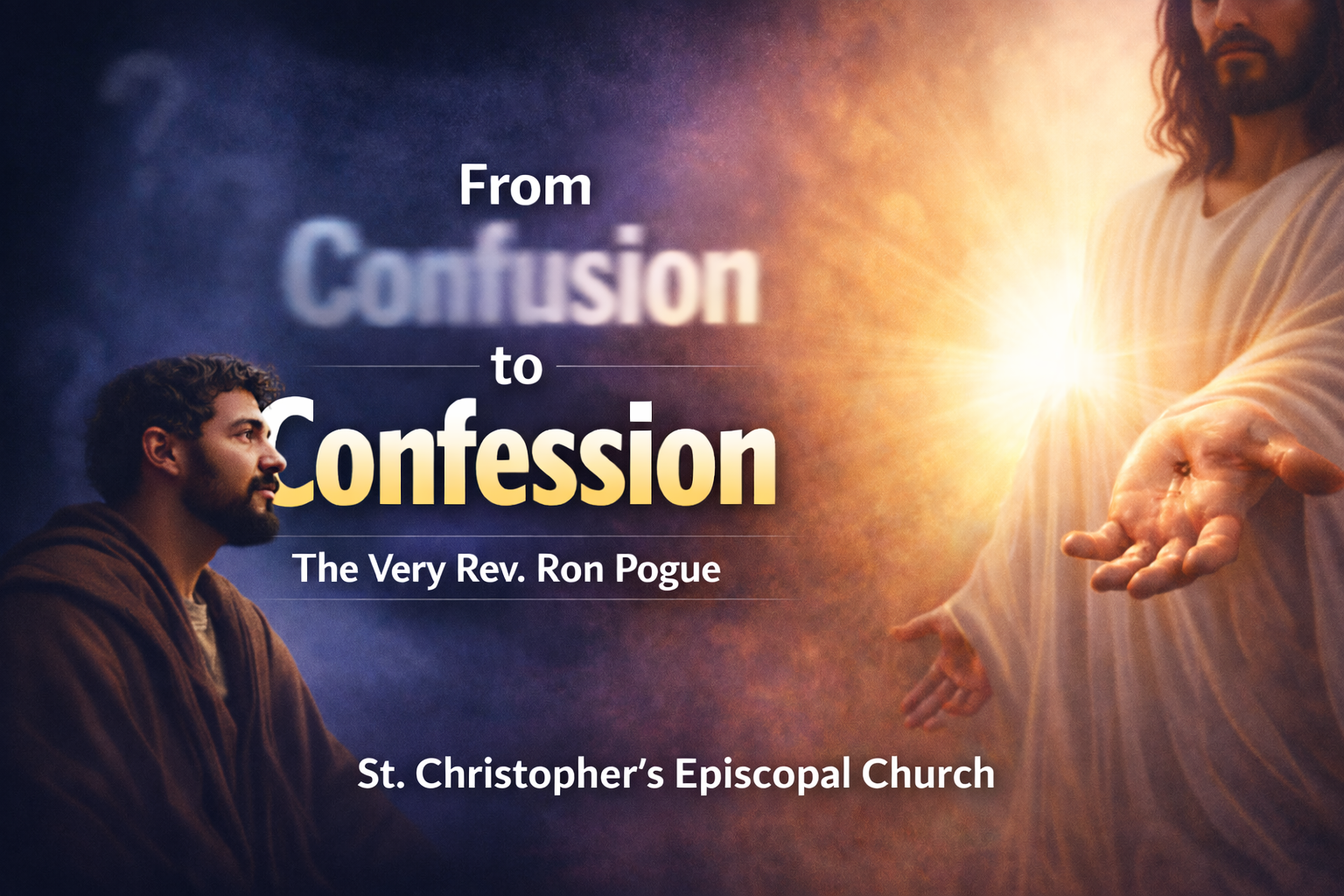
Once when a certain preacher launched into a children’s sermon, she was confronted by a visiting child, an eight-year-old friend of a regular member. The boy was new to this church but was a regular attendee at another congregation that did not have children’s sermons. Nevertheless, the visitor tried his best to follow the line of the preacher’s effort to connect with the children. Attempting to hook the children with something familiar before making her point, the priest asked the children to identify what she would describe. “What is fuzzy and has a long tail?” No response. “What has big teeth and climbs in trees?” Still no response. After she asked, “What jumps around a lot and gathers nuts and hides them?” the visiting boy could stand the silence no longer. He blurted out, “Look, lady, I know the answer is supposed to be ‘Jesus,’ but it sure sounds like a squirrel to me.” Today’s Gospel reveals to us St. Thomas – who was put in a situation similar to that of the boy at the children’s sermon. Thomas was the one who had not seen the risen Jesus when he first appeared to the disciples. The others told him they had seen the Lord, but he was skeptical. He doubted. Still, Thomas must have wanted to fit in. He might have said, “Look, friends, I know the answer is supposed to be that I acknowledge that you saw Jesus, but it sure sounds like a ghost to me.” Aren't we all a little like Thomas? Thank God for that! Because, as Elton Trueblood once said, “a faith that is never questioned isn't worth having.” Thomas remained with the others until his doubts and uncertainties were transformed into a dynamic faith. Doubt is a universal human experience. We have all felt the pain, the harassment, and the threat of it. Doubt comes in different depths. The deepest form denies that we can believe anything at all. The other extreme is the mind of the dogmatic that sails along with unquestioning confidence on a sea of tranquil certitude. While there is a certain appeal in dogmatic tranquility, there is also the danger that we might overlook the possibility of error in our most familiar beliefs. As much as we might like to think of eliminating any trace of doubt in our life, the truth is that it would be undesirable, even if it were possible. When someone tells me that he has never had a moment of probing religious doubt, I find myself wondering whether that person has ever known a moment of vital religious conviction. For if one fact stands out above all others in the history of religion, it is this: the price of a great faith is a great and continuous struggle to get it, to keep it, and to share it. Faith is a fight as well as a peace. I find myself thinking of my task as a Pastor and Teacher in the way described by Paul Tillich, when he said, “Sometimes I think my mission is to bring faith to the faithless and doubt to the faithful.” Tuesday of this week is the annual remembrance of the Holocaust, Yom Hashoah. As we recall that tragic chapter in human history, we are painfully reminded of Adolf Hitler. Hitler was an atheist. We usually think of atheism as ultimate doubt. But when you think of it as a religion, you can see how helpful it would be to have a system of doubt to correct it. Hitler had no religion to cast doubts on his approach to life. But there are other problems besides Hitler's form of atheism. There is, for example, practical atheism. Practical atheists believe in God. He just doesn't have anything to do with their lives. Martin Luther once wrote, “There is the person who has never doubted that God is, but who lives as though God were not; and there is the person who doubts whether God is, or even denies that God is, but lives as though God were. In the latter, the grace of God is at work.” Look at the lives of the saints. According to holy legend, doubt appears as a temptation which increases in power with the increase of saintliness. In those who rest on their unshakable faith, pharisaism, fundamentalism, and fanaticism are the unmistakable symptoms of doubt which has been repressed. Doubt is overcome not by repression but by courage. Courage does not deny that there is doubt, but it takes the doubt into itself as an expression of its own finitude and affirms the content of an ultimate concern – a concern that impacts our lives and how we relate to the world around us and the people in it. Courage does not need the safety of unquestionable conviction. It includes the risk without which no creative life is possible. The Christian faith is stronger than our doubts. It is like the Chinese proverb, which says, “Chinese sails, though full of holes, still work.” Suppose a half dozen of us were seated around the walls of a darkened room. We are told that somewhere in the open, middle space, there is a chair. It is not just any chair; it is an antique, the creation of a noted designer, worth several thousand dollars. Which of us will find that chair? Certainly not those who sit still and philosophize about where the chair might be placed, about its existence, or about its value. No, the chair can be found only by those who have the courage to get up and risk stumbling around in the dark, using whatever powers of reason and sensation we might have until the chair is discovered. Or in our relationships with those we love. I have faith that my wife loves me. I feel her kindness, her caring, her loving touch - all these I interpret to mean that she loves me. Not every moment of our relationship has been perfectly romantic. We went to high school together and during that time I thought she hated me. I was wrong; she was just shy. But I came to see that her acts of love are such that, while I cannot claim absolute certainty now or about the future, I have a deep faith in her love for me. We cannot ever “know” or “verify” the experience of love with the same probability as sunrise or a lab experiment, but we have faith that love is real, is what we know to be the case, is the explanation which correctly interprets certain “scientific” experience. Those who are familiar with the scientific method know that the point is not to set out to prove a theory but to attempt to disprove it. Doubt is an essential element in the advancement of science, in the pursuit of truth, and in critical thinking. As far as we know, human beings are the only creatures on the planet, perhaps in the cosmos, endowed with the privilege and responsibility to exercise reason. Once a young man said to the philosopher, Blaise Pascal, “Oh that I had your creed, then I would live your life.” Pascal replied, “let me tell you something, young man. If you will live my life, it will not be many days until you have my creed.” In other words, Pascal is saying it is easier to act your way into belief than the other way around. And when we see Thomas after the resurrection, we follow the trajectory of his faith from confusion to confession. The risen Christ, at last, confronted him in the presence of the others and together they dealt with his doubt until it gave way to affirmation. He does that for us, too. In an era when many people in power have a view of Christian faith that is very narrow and contained in a very confined context, I am grateful to be in a Church that has room for doubt and is open to questions. Those who come to us with those doubts and questions receive a genuine welcome and are lovingly embraced so that we can journey and grow together in faith, hope, and love. 
By Paula Jefferson April 6, 2026
By Paula Jefferson March 29, 2026
March 22, 2026
By Paula Jefferson March 16, 2026
By Paula Jefferson March 8, 2026
In 2017, I visited Jacob's Well. We stood in a circle and read today’s Gospel text. John tells us what happened when the women encountered Jesus. But, as I worked with the text this week, I wondered what the story might sound like if it was told by the woman, rather than a narrator. So imagine, for a moment, that she is the one telling the story. As you listen, notice the conversation is like a chess match—each question invites the conversation to deepen. I did not go to the well that day looking for God. I went because the jar was empty. You know how life is. Morning comes, the sun climbs higher than you expect, and before long the ordinary tasks are piling up: Bread to bake; Water to draw. Work that does not ask what kind of person you are—it simply asks to be done. So I took my jar and walked the familiar road to Jacob’s well. It was the middle of the day. No shade, no breeze. I preferred it that way. If you go early in the morning, everyone is there. The conversations begin before the bucket even touches the water. People talk about crops, about marriages, about children. And sometimes about other people’s lives. My life has been the subject of those conversations. So, I go at noon. Alone. But that day there was a man sitting beside the well. At first, I thought he must be a traveler resting his feet. The dust on his robe said he had come a long way. But when I looked more closely, I saw something else. He was a Judean. Now you have to understand something about that. Judeans and Samaritans do not usually share wells, cups, or conversations. We have our mountain, they have their temple, and between those two places lies a long history of arguments. So I lowered my eyes and went about my work. If I kept quiet, perhaps he would too. But then he spoke. “Give me a drink.” I looked up. Surely, I had misunderstood. “You are a Judean,” I said, “and I am a woman of Samaria. How is it that you ask me for a drink?” He did not apologize. He did not withdraw the request. Instead, he said something even more strange. “If you knew the gift of God,” he said, “and who it is that is saying to you, ‘Give me a drink,’ you would have asked him, and he would have given you living water.” Now I have drawn water from that well since I was a kid. My parents did. My grandparents did. The well is deep, and the water is good, but no one draws it without a rope and a jar. I looked at his empty hands. “Sir, you have no bucket, and the well is deep. Where do you get this living water? Are you greater than our ancestor Jacob, who gave us the well?” He did not laugh at my question. “Everyone who drinks this water will be thirsty again. But those who drink the water I give will never thirst. The water I give will become a spring inside you, giving eternal life.” A spring inside me? That was a bold claim. And if it was true, it would change everything. “Sir, give me this water, so that I may never be thirsty or have to keep coming here to draw water.” Then he did something unexpected. He said, “Go call your husband.” Now that is the moment when most people begin telling my story as if it were only about my past. I answered him honestly. “I have no husband.” And he looked at me—not the way people in town look when they think they already know who you are. He looked at me as if he could see the whole of my life at once. “You are right,” he said. “You have had five husbands, and the one you have now is not your husband.” He said it plainly. No accusation. Just truth. This man knew my story. All of it. And yet he was still speaking to me. “Sir, I see that you are a prophet.” And if he was a prophet, then there was a question I had always wondered about: “Our ancestors worshiped on this mountain,” I said, “But you Judeans say that the place where people must worship is in Jerusalem.” I still don’t fully understand his answer. But I remember the way he said it—as if the world we thought we understood was already passing away: “The hour is coming,” he said, “when you will worship the Father neither on this mountain nor in Jerusalem. The true worshipers will worship in spirit and truth.” Not here. Not there. Something larger. I thought of the promise our people had always carried. “I know that Messiah is coming,” I told him. “When he comes, he will proclaim all things to us.” And then he said it. “I am he.” Right there beside the well….in the middle of my ordinary day. In that moment the world shifted. The God our ancestors argued about on mountains and in temples was not far away at all. He was sitting beside me, asking for a drink. About that time his disciples came back from town. They looked surprised to see him talking to me, though none of them said a word. But by then I had forgotten why I came. Somewhere beside the well my jar was still sitting on the ground. Because suddenly the water I came for no longer seemed like the most important thing in the world. I ran back to town….to the same people who gossiped about me. “Come and see a man who told me everything I have ever done! Can he be the Messiah?” They came. Many believed because of my testimony. But later they said something even better. “It is no longer because of your testimony that we believe,” they told me. “Now we have heard for ourselves.” And that is how encounter works. You come to the well carrying whatever jar life has given you—your history, your reputation, the ordinary work of your days, the burdens that seem overwhelming… And Christ meets you there. He speaks your truth. He offers living water. And before you know it, the jar that once defined your life is sitting forgotten beside the well. Because the water you were looking for is no longer something you carry in your hands. It has become a spring within you. God is alive. God is among us. God is here. God is now. Come and see.
By Melanie Kingsbury March 1, 2026
By Paula Jefferson February 22, 2026
Show More