
There are many styles of preaching. Some preachers are pastoral. Others are teachers. Some invite participation, and some go past theology altogether and just grab our emotions.


Today, Luke took us to the John the Baptist School of Preaching.


Once John’s congregation gathered, he began with these words of welcome: "You brood of vipers! Who warned you to flee from the wrath to come?"


Apparently, John is a “Buckle up, buttercup” kind of preacher. Certainly, he’s not reporting to the vestry about Average Sunday Attendance!  There is no pastoral, soft landing in John’s message. There are no shades of gray in his words. 


John was called to preach one, very specific message: The Messiah is coming. Repent & Prepare to receive him!


The crowds that gathered around John came to be baptized. In those days, baptism by water was a sign of repentance…a desire to be in right relationship with Yahweh. It also restored people to full participation in the Jewish community.[1] 


In other words, the folks who came to John wanted to restore their lives to the way they were. 


John said, ‘that’s not enough’. If repentance for you means a ritual to get back to what was…don’t bother.


And, so the people ask, “What then…what else must we do… to truly repent?”


He replied: If you have two coats, share with anyone who has none. If you have extra food, share with those who do not. To the tax collector, do your vocation honorably. Don’t take more than the amount you are required to take.


John was saying, ‘Don’t go back to the way you used to do things. Live the golden rule—treat your neighbor as you would like to be treated’.  To John, bearing this kind of good fruit is a kind of proof that repentance has truly taken root in our lives.   


He had no patience for religious ritual that did not lead to personal change.


Two thousand years later, a Christian theologian named Dietrich Bonhoeffer wrote in a similar vein. He said the preaching of forgiveness without requiring repentance -- real change -- is cheap grace. 

John lived in a religious culture filled with corruption, oppression, hunger, disease. Jewish customs and religious practices were often in conflict with Roman customs and authority.  Life in Israel/Judah was like Gotham City without Batman and Robin. 


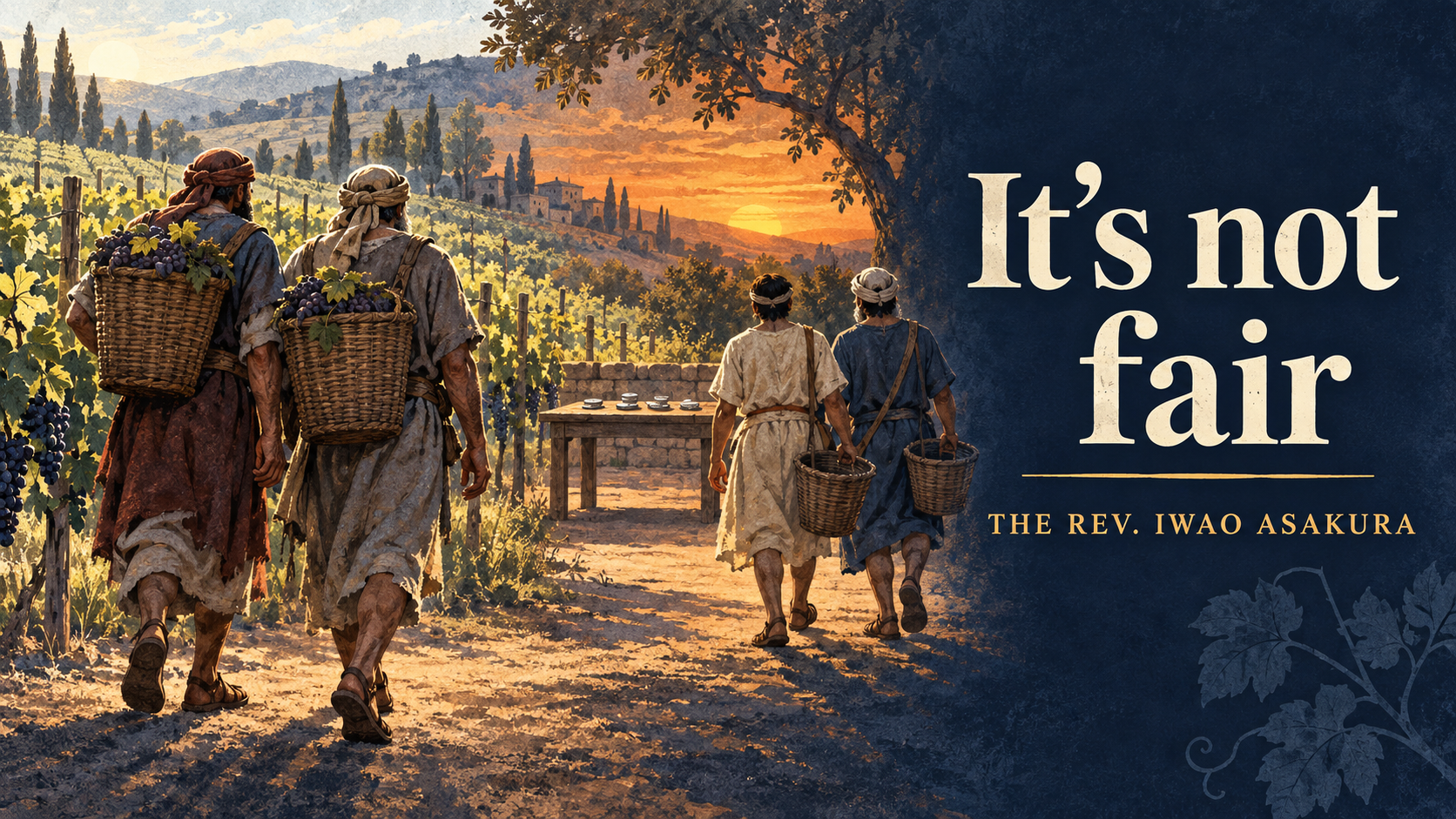
Against that backdrop, John preached a new message, one that flipped the tables on the status quo. 


His words were so different than anything the people had experienced, they began to wonder, “Is he the Messiah”? That was John’s cue to preach the crux of his message: The one who is coming is much more powerful than me. I baptize with water (they way it had always been).  He will baptize with the Holy Spirit and fire.


The Messiah, he said, will separate the wheat from the chaff. The wheat will be gathered unto himself and the chaff will burn with unquenchable fire. 


Like many of you, I grew up in a denomination that interpreted this metaphor to mean that Jesus would cull through humanity and set apart the good folks…the ones who matched up with our definition of good…and everyone else would be cast aside, like chaff. 


It is human ego that imagines we know God’s mind; and human bias that imagines we know God’s litmus test for right and wrong, good and evil, believer or not. 


This week I wondered if we have missed the real point of John’s metaphor?


In every stalk of wheat, there is both the seed and the chaff. And so it is with each of us. There is the good seed that God has planted in us. And there is the chaff, the stuff that gets in our way of being all that God has created and called us to be.


What I like about this interpretation is that there’s no need to point the finger at other people…judging who I think is heaven-bound and who is not…based upon some litmus test that Paula Jefferson has crafted over the past 63 years. Instead, I’m looking in the mirror…owning those parts of myself that God did not plant.


I recognize those parts in me. We all do.


Advent is an intentional time to prepare ourselves to receive a holy gift. Part of our preparation work is clearing the chaff that takes up space in our hearts. 

Forgiveness, repentance, confession….each, in its own way, is a surrender of self and an embrace of God’s bountiful grace.  


The candles of Advent represent hope, peace, joy, love, and Christ. These are the gifts God has planted in you. The very best part of God’s wheat is in you. 


   [1] https://www.google.com/search?q=what+is+the+meaning+of+baptism+in+judaism%3F&rlz=1C1CHBF_enUS971US971&oq=what+is+the+meaning+of+baptism+in+judaism%3F&gs_lcrp=EgZjaHJvbWUyBggAEEUYOTIHCAEQIRigATIHCAIQIRigATIHCAMQIRigATIHCAQQIRifBTIHCAUQIRifBTIHCAYQIRifBTIHCAcQIRifBTIHCAgQIRifBTIHCAkQIRifBdIBCTk5NjJqMGoxNagCCLACAQ&sourceid=chrome&ie=UTF-8

By Paula Jefferson August 9, 2026
By Paula Jefferson August 8, 2026
The first time I met Margie Major, she looked me up and down. Goodness knows how many Episcopal priests she had welcomed into her 101-year life. I suspect I was the first woman to be her priest. We talked, found common ground in our dogs and God. And then she asked a question I would hear on every visit: “Paula, where are my people?” Margie worshiped faithfully with St. Christopher’s through our livestream. That opportunity was possible because her great-niece, Lauryn, made it happen. During COVID, Lauryn volunteered her time and expertise to design the livestream system that still serves our congregation today. And that was also how Margie noticed who had been gathered for worship…and who was missing. Margie knew her flock. Shepherds aren’t very common today. But the crowd gathered around Jesus was very familiar with sheep and shepherds. Jesus reached into ordinary life and said, “If you want to know what God is like, look at a shepherd.” And then he told the story of the good shepherd. “I know my own, and my own know me…”. Here’s the Gospel sentence that drew my attention all week: “And I lay down my life for the sheep.” Jesus is foreshadowing the cross. But he’s also speaking of something more than one Friday afternoon. The cross reveals the shape of the life he is already living. What does it mean to “lay down one’s life?” I don’t think Jesus means one heroic moment. Shepherds don’t lay down their lives only when a wolf appears. They lay down their lives every day—their lives become ordered around the well-being of the flock. That’s the link I’ve been seeing all week between Margie’s life and the good shepherd. She didn’t wake up one morning prepared to shepherd students through desegregation, or to help found St. Simon of Cyrene, or to accompany generations of young people into adulthood. That kind of life isn’t improvised. It is formed. Over years of prayer, worship, Scripture, and Holy Communion, Christ was quietly shaping Margie into the kind of person who could give her life away without counting the cost. That kind of strength and humility reveal a life that is Christ-centered. She didn’t have to tell us. We saw it. Margie set the bar high….for herself…and for everyone she loved. She didn’t set the bar out of reach—but just past the place comfort….the place where growth begins. When Margie entered the room, we stood a little straighter, dug a little deeper. For her 100 th birthday celebration, Etta Attkinson and Edwardean Harris helped write a proclamation honoring Margie’s life through their eyes as her former students and members of St. Simon-of-Cyrene. We spent an afternoon turning their memories into proclamations. A few of my favorites…. “Whereas, Margie was an educator at the historical I.M. Terrell High School and an administrator at Paschal High School, and who was known to walk softly and carry a giant stick…. and, Whereas, Margie earned her students’ trust by demonstrating that she would honor their confidentiality; and, Whereas, Margie is respected among friends and colleagues for her wisdom, generosity, sophistication, and love of family….and on and on. pause Shortly after her birthday celebration, I visited Margie at home. She was feeling strong that day and wanted to meet in the formal living room. I had never been invited to that space. Margie had an agenda. We talked about peace…the inside kind, a life well-lived, the importance of faith in this life. We prayed…anointed. And then, of course, she put that question to me: where are my people? I had learned by then that she wasn’t taking attendance. She was asking the shepherd’s question: ‘Are my people still being gathered by the Good Shepherd?’. pause Last week, I wrote to Bishop Andy Doyle to let him know that a founding member of St. Simon of Cyrene had died and to share with him the words read into the Congressional Record of the United States upon Margie’s 100 th birthday. In his reflection, Bp Doyle recalled Mary of Bethany… In the house at Bethany, something unexpected happened, a woman broke open a jar of ointment. No one had asked her for it. No one had earned it. She poured it out over feet that would soon carry him toward the cross, and John tells us the whole house filled with the fragrance. The love came first. The understanding came later, and for some it never came at all. There is something here about Margie, he said. She loved us before we knew how to receive it. This is why she founded a church! The love was given long before any of us thought to give it back, and before I met her. We can count what she built. Count what she did, who she served, and how she provided. Count and give thanks to God. Read that list aloud and it will still fall short, because the list records what her hands did while saying almost nothing about why the room changed when she was in it. I’ve wondered this week what it was about Margie that changed a room when she entered it. It wasn’t power. It wasn’t position. I think it’s that she carried the quiet authority of a life deeply rooted in Christ. Margie had the rare gift of helping other people become the very people God created them to be. Around her, we wanted to become a little kinder, a little wiser, a little more faithful. We stood a little straighter—not because she demanded it, but because she called forth the best in us. Bp Doyle said, The Church has a word for something or someone who carries a grace beyond our seeing. We call it a sign. Margie was a sign of so many of God’s promises. What we loved in her was never hers. It was poured into her and then poured out on us. She was a steward of godly things. Paul told the Corinthians they had become the aroma of Christ. He meant it about people who had been near enough to Jesus that the scent stayed on their clothes. Here is Bethany. The jar is broken now. The fragrance is still in the house. It is in you, in the way you welcome the stranger she would have welcomed, in the work she started that your hands will continue. Blessings to you all, Bishop Andy The Rt Rev C. Andrew Doyle Episcopal Diocese of Texas Bishop Andy is right…the fragrance remains. It is here … in this very room. It lingers in the lives she shaped, in the students she encouraged, in the church she helped to build, in the family she cherished, in the woman priest she taught to be a shepherd, and in every person who learned from Margie what it means to follow the Good Shepherd. But that fragrance is not our hope. The fragrance is a gift…and a sign. But it is not the Gospel. The Gospel is this: Christ is risen. The Good Shepherd who called Margie by name in Baptism has now called her through death into eternal life. That is our hope. Margie asked, “Paula, where are my people?” Margie, your people are here. We are here because you loved us. We are here because you spent 101 years pointing us toward the Good Shepherd. And one day, by the grace of God, we will be with you. That’s the resurrection. With thanksgiving for the life of Margie Major…Amen.
By Paula Jefferson July 26, 2026
By Melanie Kingsbury May 17, 2026
By Paula Jefferson May 10, 2026
By Paula Jefferson May 3, 2026
April 12, 2026
Once when a certain preacher launched into a children’s sermon, she was confronted by a visiting child, an eight-year-old friend of a regular member. The boy was new to this church but was a regular attendee at another congregation that did not have children’s sermons. Nevertheless, the visitor tried his best to follow the line of the preacher’s effort to connect with the children. Attempting to hook the children with something familiar before making her point, the priest asked the children to identify what she would describe. “What is fuzzy and has a long tail?” No response. “What has big teeth and climbs in trees?” Still no response. After she asked, “What jumps around a lot and gathers nuts and hides them?” the visiting boy could stand the silence no longer. He blurted out, “Look, lady, I know the answer is supposed to be ‘Jesus,’ but it sure sounds like a squirrel to me.” Today’s Gospel reveals to us St. Thomas – who was put in a situation similar to that of the boy at the children’s sermon. Thomas was the one who had not seen the risen Jesus when he first appeared to the disciples. The others told him they had seen the Lord, but he was skeptical. He doubted. Still, Thomas must have wanted to fit in. He might have said, “Look, friends, I know the answer is supposed to be that I acknowledge that you saw Jesus, but it sure sounds like a ghost to me.” Aren't we all a little like Thomas? Thank God for that! Because, as Elton Trueblood once said, “a faith that is never questioned isn't worth having.” Thomas remained with the others until his doubts and uncertainties were transformed into a dynamic faith. Doubt is a universal human experience. We have all felt the pain, the harassment, and the threat of it. Doubt comes in different depths. The deepest form denies that we can believe anything at all. The other extreme is the mind of the dogmatic that sails along with unquestioning confidence on a sea of tranquil certitude. While there is a certain appeal in dogmatic tranquility, there is also the danger that we might overlook the possibility of error in our most familiar beliefs. As much as we might like to think of eliminating any trace of doubt in our life, the truth is that it would be undesirable, even if it were possible. When someone tells me that he has never had a moment of probing religious doubt, I find myself wondering whether that person has ever known a moment of vital religious conviction. For if one fact stands out above all others in the history of religion, it is this: the price of a great faith is a great and continuous struggle to get it, to keep it, and to share it. Faith is a fight as well as a peace. I find myself thinking of my task as a Pastor and Teacher in the way described by Paul Tillich, when he said, “Sometimes I think my mission is to bring faith to the faithless and doubt to the faithful.” Tuesday of this week is the annual remembrance of the Holocaust, Yom Hashoah. As we recall that tragic chapter in human history, we are painfully reminded of Adolf Hitler. Hitler was an atheist. We usually think of atheism as ultimate doubt. But when you think of it as a religion, you can see how helpful it would be to have a system of doubt to correct it. Hitler had no religion to cast doubts on his approach to life. But there are other problems besides Hitler's form of atheism. There is, for example, practical atheism. Practical atheists believe in God. He just doesn't have anything to do with their lives. Martin Luther once wrote, “There is the person who has never doubted that God is, but who lives as though God were not; and there is the person who doubts whether God is, or even denies that God is, but lives as though God were. In the latter, the grace of God is at work.” Look at the lives of the saints. According to holy legend, doubt appears as a temptation which increases in power with the increase of saintliness. In those who rest on their unshakable faith, pharisaism, fundamentalism, and fanaticism are the unmistakable symptoms of doubt which has been repressed. Doubt is overcome not by repression but by courage. Courage does not deny that there is doubt, but it takes the doubt into itself as an expression of its own finitude and affirms the content of an ultimate concern – a concern that impacts our lives and how we relate to the world around us and the people in it. Courage does not need the safety of unquestionable conviction. It includes the risk without which no creative life is possible. The Christian faith is stronger than our doubts. It is like the Chinese proverb, which says, “Chinese sails, though full of holes, still work.” Suppose a half dozen of us were seated around the walls of a darkened room. We are told that somewhere in the open, middle space, there is a chair. It is not just any chair; it is an antique, the creation of a noted designer, worth several thousand dollars. Which of us will find that chair? Certainly not those who sit still and philosophize about where the chair might be placed, about its existence, or about its value. No, the chair can be found only by those who have the courage to get up and risk stumbling around in the dark, using whatever powers of reason and sensation we might have until the chair is discovered. Or in our relationships with those we love. I have faith that my wife loves me. I feel her kindness, her caring, her loving touch - all these I interpret to mean that she loves me. Not every moment of our relationship has been perfectly romantic. We went to high school together and during that time I thought she hated me. I was wrong; she was just shy. But I came to see that her acts of love are such that, while I cannot claim absolute certainty now or about the future, I have a deep faith in her love for me. We cannot ever “know” or “verify” the experience of love with the same probability as sunrise or a lab experiment, but we have faith that love is real, is what we know to be the case, is the explanation which correctly interprets certain “scientific” experience. Those who are familiar with the scientific method know that the point is not to set out to prove a theory but to attempt to disprove it. Doubt is an essential element in the advancement of science, in the pursuit of truth, and in critical thinking. As far as we know, human beings are the only creatures on the planet, perhaps in the cosmos, endowed with the privilege and responsibility to exercise reason. Once a young man said to the philosopher, Blaise Pascal, “Oh that I had your creed, then I would live your life.” Pascal replied, “let me tell you something, young man. If you will live my life, it will not be many days until you have my creed.” In other words, Pascal is saying it is easier to act your way into belief than the other way around. And when we see Thomas after the resurrection, we follow the trajectory of his faith from confusion to confession. The risen Christ, at last, confronted him in the presence of the others and together they dealt with his doubt until it gave way to affirmation. He does that for us, too. In an era when many people in power have a view of Christian faith that is very narrow and contained in a very confined context, I am grateful to be in a Church that has room for doubt and is open to questions. Those who come to us with those doubts and questions receive a genuine welcome and are lovingly embraced so that we can journey and grow together in faith, hope, and love. 
By Paula Jefferson April 6, 2026
By Paula Jefferson March 29, 2026
Show More