


Today, my favorite psalm is featured in the readings. Psalm 100 is kind of like a 1966 Chevy Chevelle—the car my first boyfriend drove. It looked perfectly at home in the grocery store parking lot. But under the hood, there was a V8 that produced 375 horsepower. Getting to the grocery store was a whole lot of fun. I want to take you back to Sunday, September 6, this year. St. Christopher’s went to a Texas Rangers game. There were 136 of us cheering on the good guys. In the bottom of the second inning, Jake Burger made contact with a pitch that soared toward the outfield wall. I was on my feet, holding my breath, watching the ball fly. When it cleared the fence, the whole crowd erupted in cheers. The Rangers set off fireworks to celebrate the home run. It was a moment of utter jubilation. Hang on to that moment. The Book of Common Prayer has its own Psalter. These aren’t the NRSV psalms. They are written for worship—for reading aloud, praying and chanting (as we do) together.[1] Sometimes, the English words do not reflect the fullness of the psalmist’s intent. There are two Hebrew verbs in this psalm whose force is difficult to capture fully in English. One is often known in the Latin tradition as jubilate; the other means to bless. Jubilate. The Prayer Book says, “Be joyful.” But the Hebrew verb carries something much more emphatic—like a shouted cry of joy. St. Augustine of Hippo,[2] writing about this very psalm in the fourth century, wondered what it meant to jubilate. He described people working in the fields at harvest. They're gathering the crops, delighted by the abundance of the earth. They sing as they work. But sometimes their joy becomes so great that the words of their songs aren't enough. They break into cries of delight that have no words. Augustine called this jubilation: “a certain sound of joy without words.” It's what happens when the heart is so full that language simply cannot contain it. On September 6, when Jake Burger's ball cleared the wall at Globe Life Field, I wasn't thinking about how wonderful baseball is or composing a sentence about my gratitude for the Texas Rangers. I was screaming at the top of my lungs! That's jubilation. The psalmist, then, commands us to bring that kind of joy to God. Not just happiness or good vibes. Not just appreciation. But the kind of joy that overtakes us, that leaves us momentarily without words. Jubilate! All the earth! And then there's the second verb: to bless. But that’s not the word we sang today. The Prayer Book invites us to “Call upon his Name.” That’s something we do all the time. We bring our needs, our hopes, our fears, our prayers. But the Hebrew text offers us another invitation: “Bless his name.” That’s a very different invitation! Rather than turning to God with something we need, the psalmist is asking us to turn our attention toward God—to acknowledge and give thanks for God’s goodness, God’s steadfast love and God’s faithfulness that endures from generation to generation. In other words, we’re not only asking God to bless us. We’re being invited to recognize the One who is already blessing us and to respond by blessing God’s name. How do we jubilate and bless God’s name in a way that honors the psalmist’s understanding of those words? Look at the bee on the cover of today's bulletin. A bee goes about the work for which it was created. It moves from flower to flower, gathering nectar, carrying pollen, making possible the abundance of the natural world. The bee doesn’t consciously choose to praise God. But simply by being what it was created to be, doing what it was created to do, it participates in—and displays—the goodness of God’s creation. Humans have different gifts. We have the capacity to recognize the goodness of creation, to recognize the One from whom that goodness comes, and to respond. We have the ability to bless God’s name with our voices on Sunday morning. And we can intentionally bless God with the way we live our lives. When we feed someone who is hungry rather than hoard what we have, we bless God’s name. When we make room for someone who feels excluded or choose reconciliation when holding a grudge would be easier, we bless God’s name. We become participants in the goodness of God. Our lives become an expression of the goodness, steadfast love and faithfulness we have praised. May we live in such a way that the goodness of God becomes as visible through us as it is through the bee. Jubilate! All the earth! And bless his holy name. Notes [1] The 1979 Book of Common Prayer, pp. 582–583. [2] Augustine’s Exposition on Psalm 100 (numbered 99 in his text).
I grew up in the First Baptist Church of Knoxville, Pennsylvania. Our church gave a Bible to any student who attended 100% of the Sunday School classes in any given school year. Never one to shy away from a challenge, I was determined to earn that Bible in First Grade. But, in the Spring, I got the mumps. In Second Grade, I made it … all year long. On the Sunday before summer break, I received an RSV Bible. It is, in fact, the Bible that Carmen handed to me when I was installed as your Vicar. School was out and I had lots of time. On rainy days, I’d sit at our kitchen table with a red pencil (underlining words I didn’t understand or couldn’t pronounce) and a regular pencil…writing questions for my parents. I drove my family nuts that summer. At 8 years old, I couldn’t recognize poetry from prose, hyperbole from understatement, parable from narrative. But I was marching my way through all of it. One day, as I was sitting with a perplexing story, a light bulb went on…an epiphany. It was a paradox…and I couldn’t make any sense of it. I ran to my grandmother’s house: Grandma, I’ve read something that is big…but I don’t get it. I’m alive and I’m dying. How can I be both? Grandma asked, “What in the Sam Hill are you reading, now?” “The Bible.” Amy-Jill Levine, a Bible scholar, likes to say that we often try to domesticate Jesus’ parables…to strip away the uncomfortable questions he stirs up. The parables are meant to disturb us. And today’s parable does not disappoint. As I reflected on the parable this week, I asked some uncomfortable questions: What kind of bridegroom locks half the bridesmaids out of the wedding? If all ten bridesmaids fell asleep, who’s wise and who’s foolish? Is failing to prepare a sin? All ten bridesmaids fall asleep. The wise aren’t rewarded for staying awake, and the foolish aren’t condemned for sleeping. The difference is that some had prepared for the possibility that waiting would be longer than expected. By the time we reach this parable in chapter 25, Jesus has spent two chapters redirecting his disciples from trying to figure out when he will return to considering what it means to be ready. We live in a world that increasingly reduces everything to binary choices. Yes/No. On/Off. In/Out. And it’s tempting to read this parable the same way. Five were prepared; five were not. Five got into the wedding; five were left outside. Case closed. We do this in the world around us, too. We draw lines around who belongs, who deserves our care, and who is entitled to the things we might take for granted. Sometimes, all it takes is a single characteristic to put someone on the other side of the line. But I wonder if Jesus is inviting us to look more deeply than that. What if the point isn’t simply to decide who is wise and who is foolish? What if the parable is asking us to examine the kind of people we are becoming while we wait. When I was eight, I stumbled into a truth I couldn't quite understand: I am, still, both alive and dying. Both are true. And perhaps that's one of the great paradoxes of our faith. We live in the present, but we belong to eternity. We cannot know how much time we have, or what tomorrow will bring. Yet we are called to live as though what we do with this life matters. That is, I think, the point Jesus is pressing in this parable. Not that we should spend our days trying to calculate when he will return (Look busy: Jesus is coming!). But that we should be attentive to the life God has given us while we wait. There is a sense of urgency in the Gospels. But it is not a panic about death. It is an urgency of love. What does that kind of urgency look like? W e don’t have to look very far. There is hunger in our neighborhoods. There is injustice in our communities. There is grief among us. Many of us are living with loss: the loss of loved ones, of physical abilities, of independence. Sometimes, the loss of the life we thought we would have. People need to be seen, heard, and welcomed. And that need isn’t somewhere over the horizon. It’s right here. Right now. And that brings us back to the oil in those lamps. I like to imagine that the oil is the hope that sustains us while we wait. Not simply hope for some distant future, but hope that gives us the courage to live faithfully today. Hope is not simply believing that things will eventually get better. It is trusting that God's love is at work in the world, even when the evidence around us suggests otherwise. And that hope gives us the courage to keep loving, keep serving, and keep working for the kingdom of God. Christian hope is not passive . It moves us to look honestly at the brokenness of our world without surrendering to it. It calls us to feed the hungry, challenge injustice, accompany those who grieve, and stand alongside those who have been pushed to the margins. These are things we do as we wait for God’s kingdom to come in its fullness, AND they are ways we participate in that kingdom here and now. We cannot be content to offer kindness while leaving injustice unchallenged. We cannot draw lines around who belongs, who deserves our care, or whose suffering matters. We cannot proclaim a kingdom of love while accepting a world that withholds love from some of God’s children. We don’t keep our lamps burning because someday we might need them. We keep them burning because the world needs their light now. The bridegroom may be delayed. But the work of love cannot wait.
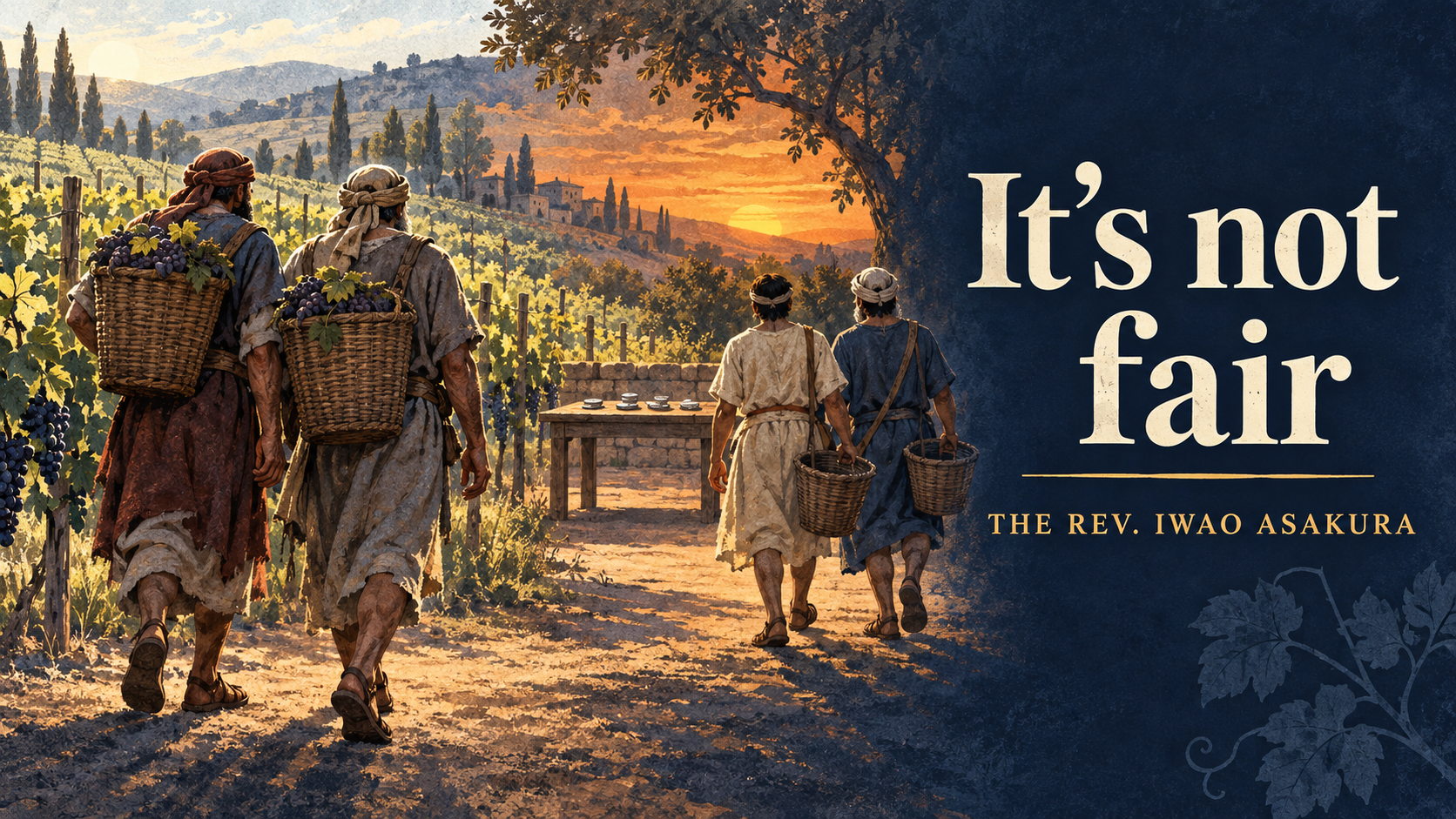

When I adopted my dog, Scrappy, he was 9 months old. He was found on the streets of Euless—and because he was a puppy, the animal control folks invested in him. He was neutered and moved to an animal shelter where I found him. When he came to us, it was clear that he had never lived in a home. The first evening, I fed Dursey and Scrappy together. That was a mistake. Scrappy immediately went after Dursey to get Dursey’s food. There was growling, barking, and bared teeth between the two dogs, so I reached for Scrappy’s bowl. That was also a mistake. It was my first encounter with food guarding. Scrappy was used to roaming the streets, searching for food, protecting whatever he found from other scavengers. He was fighting to protect the food I had given him—and then he started trying to take Dursey’s, too. Scarcity and survival had shaped Scrappy’s understanding of the world. ….pause…. Matthew tells us the parable of the unforgiving servant. A king summons a slave to repay what he has borrowed from the king. He cannot repay. Therefore, the king orders that he, his family, and his possessions be sold so that the king’s bank account will be restored. There is no compassion here. No mercy. This is simply business as usual: Pay up or be sold. Then the parable took an interesting turn. The debtor falls on his knees and begs the king for patience so that he could repay the debt over time. He’s not asking to be released from the debt. He’s asking for more time. But the king does something the debtor isn’t expecting. Rather than giving more time, the king releases him—and forgives the debt. All of it. In that moment, his life –and that of his family—changes dramatically. He has lived his whole life in an economy of debt. Someone is owed. Someone pays. And, now, out of the blue, the king says: You don’t owe me anymore. The man walks out. Almost immediately, he meets a fellow servant who owes him money. He grabs the man and demands payment. The servant says to him the very words he had just spoken to the king: “Have patience with me, and I will pay you.” But he refuses. He has the man thrown into prison. The unforgiving servant received a gift—but it was such a foreign experience, he did not know how to live inside it. …pause… What is a gift? In tax theory (my turf), a gift is something of value given without strings attached …without an expectation that something will be returned to the giver, and without the giver controlling what the recipient does with it. Was the king’s debt forgiveness really a gift? The king never tells the servant, “I am forgiving this debt on the condition that you forgive the debts of others.” There is no stated condition in the story. And, yet, when the king learns what the servant has done, he takes the forgiveness back. He restores the debt and sends the servant to prison. What kind of gift is that? The king introduces something that looks like a gift economy—and then, when the recipient fails to behave according to the rules of that economy, the king returns to an economy of debt. …pause… After that first disastrous feeding, I learned to feed Scrappy in a separate room…my bedroom. And he learned the ritual that made his meal appear: Scrappy, Come. Scrappy, Sit. Scrappy, Wait. The bowl goes to floor. I take his head into my hands and say, “I love you Scrappy. There will always be enough.” And then he eats. I know he does not understand what those words mean. But he does understand the ritual. He knows what happens next…he has learned that he doesn’t have to fight for his food. He can wait. There will be enough. …pause… We become what our relationships teach us about the world. Scrappy learned that food was scarce. He learned to grab…to protect. It took time for him to learn something different. He had to experience it – again and again. I wonder if that is part of what Jesus is getting at in this parable. The servant has been forgiven an impossible debt. He has been given a completely new reality. But he walks right back into the old one: You owe me. Pay up. The parable isn’t simply saying, “Forgive, because that’s the rule.” It is showing us the consequences of a community in which people cannot trust that there will be enough mercy to go around. …pause… We know what that feels like. When we think there isn’t enough forgiveness, grace, recognition, love, we start keeping score. I forgave you last time. I’ve given enough. I’ve done my part. Just like that…forgiveness becomes a transaction…a ledger sheet. …pause… Jesus is inviting us to something very different: “I release this debt.” Period. Because, there is enough….enough mercy, enough grace, enough love. This is the kind of community St. Christopher’s is becoming--a place where forgiveness and mercy are given freely—not because we expect something in return, but because we have received them freely, ourselves. Every time we choose mercy instead of keeping score, we practice a different way of living. …pause… This morning, I opened the back door and called, “Scrappy, Come. Breakfast.” He ran into the house…running so fast he couldn’t make the 90-degree turn into my bedroom hallway. He had to run through the living room to slow down, then to my bedroom. He ran in frenzied circles until I said, “Scrappy, Sit. Scrappy, Wait.” I put down the bowl, took his head in my hands and said, “I love you, Scrappy. There will always be enough. Always.” Then I came here….Jesus called to us, “Y’all Come. Worship.” And we gathered, with joy and hope and all the rest that is within us. “Come. Sit. Wait. I love you. There will always be enough. Always.”

The first time I met Margie Major, she looked me up and down. Goodness knows how many Episcopal priests she had welcomed into her 101-year life. I suspect I was the first woman to be her priest. We talked, found common ground in our dogs and God. And then she asked a question I would hear on every visit: “Paula, where are my people?” Margie worshiped faithfully with St. Christopher’s through our livestream. That opportunity was possible because her great-niece, Lauryn, made it happen. During COVID, Lauryn volunteered her time and expertise to design the livestream system that still serves our congregation today. And that was also how Margie noticed who had been gathered for worship…and who was missing. Margie knew her flock. Shepherds aren’t very common today. But the crowd gathered around Jesus was very familiar with sheep and shepherds. Jesus reached into ordinary life and said, “If you want to know what God is like, look at a shepherd.” And then he told the story of the good shepherd. “I know my own, and my own know me…”. Here’s the Gospel sentence that drew my attention all week: “And I lay down my life for the sheep.” Jesus is foreshadowing the cross. But he’s also speaking of something more than one Friday afternoon. The cross reveals the shape of the life he is already living. What does it mean to “lay down one’s life?” I don’t think Jesus means one heroic moment. Shepherds don’t lay down their lives only when a wolf appears. They lay down their lives every day—their lives become ordered around the well-being of the flock. That’s the link I’ve been seeing all week between Margie’s life and the good shepherd. She didn’t wake up one morning prepared to shepherd students through desegregation, or to help found St. Simon of Cyrene, or to accompany generations of young people into adulthood. That kind of life isn’t improvised. It is formed. Over years of prayer, worship, Scripture, and Holy Communion, Christ was quietly shaping Margie into the kind of person who could give her life away without counting the cost. That kind of strength and humility reveal a life that is Christ-centered. She didn’t have to tell us. We saw it. Margie set the bar high….for herself…and for everyone she loved. She didn’t set the bar out of reach—but just past the place comfort….the place where growth begins. When Margie entered the room, we stood a little straighter, dug a little deeper. For her 100 th birthday celebration, Etta Attkinson and Edwardean Harris helped write a proclamation honoring Margie’s life through their eyes as her former students and members of St. Simon-of-Cyrene. We spent an afternoon turning their memories into proclamations. A few of my favorites…. “Whereas, Margie was an educator at the historical I.M. Terrell High School and an administrator at Paschal High School, and who was known to walk softly and carry a giant stick…. and, Whereas, Margie earned her students’ trust by demonstrating that she would honor their confidentiality; and, Whereas, Margie is respected among friends and colleagues for her wisdom, generosity, sophistication, and love of family….and on and on. pause Shortly after her birthday celebration, I visited Margie at home. She was feeling strong that day and wanted to meet in the formal living room. I had never been invited to that space. Margie had an agenda. We talked about peace…the inside kind, a life well-lived, the importance of faith in this life. We prayed…anointed. And then, of course, she put that question to me: where are my people? I had learned by then that she wasn’t taking attendance. She was asking the shepherd’s question: ‘Are my people still being gathered by the Good Shepherd?’. pause Last week, I wrote to Bishop Andy Doyle to let him know that a founding member of St. Simon of Cyrene had died and to share with him the words read into the Congressional Record of the United States upon Margie’s 100 th birthday. In his reflection, Bp Doyle recalled Mary of Bethany… In the house at Bethany, something unexpected happened, a woman broke open a jar of ointment. No one had asked her for it. No one had earned it. She poured it out over feet that would soon carry him toward the cross, and John tells us the whole house filled with the fragrance. The love came first. The understanding came later, and for some it never came at all. There is something here about Margie, he said. She loved us before we knew how to receive it. This is why she founded a church! The love was given long before any of us thought to give it back, and before I met her. We can count what she built. Count what she did, who she served, and how she provided. Count and give thanks to God. Read that list aloud and it will still fall short, because the list records what her hands did while saying almost nothing about why the room changed when she was in it. I’ve wondered this week what it was about Margie that changed a room when she entered it. It wasn’t power. It wasn’t position. I think it’s that she carried the quiet authority of a life deeply rooted in Christ. Margie had the rare gift of helping other people become the very people God created them to be. Around her, we wanted to become a little kinder, a little wiser, a little more faithful. We stood a little straighter—not because she demanded it, but because she called forth the best in us. Bp Doyle said, The Church has a word for something or someone who carries a grace beyond our seeing. We call it a sign. Margie was a sign of so many of God’s promises. What we loved in her was never hers. It was poured into her and then poured out on us. She was a steward of godly things. Paul told the Corinthians they had become the aroma of Christ. He meant it about people who had been near enough to Jesus that the scent stayed on their clothes. Here is Bethany. The jar is broken now. The fragrance is still in the house. It is in you, in the way you welcome the stranger she would have welcomed, in the work she started that your hands will continue. Blessings to you all, Bishop Andy The Rt Rev C. Andrew Doyle Episcopal Diocese of Texas Bishop Andy is right…the fragrance remains. It is here … in this very room. It lingers in the lives she shaped, in the students she encouraged, in the church she helped to build, in the family she cherished, in the woman priest she taught to be a shepherd, and in every person who learned from Margie what it means to follow the Good Shepherd. But that fragrance is not our hope. The fragrance is a gift…and a sign. But it is not the Gospel. The Gospel is this: Christ is risen. The Good Shepherd who called Margie by name in Baptism has now called her through death into eternal life. That is our hope. Margie asked, “Paula, where are my people?” Margie, your people are here. We are here because you loved us. We are here because you spent 101 years pointing us toward the Good Shepherd. And one day, by the grace of God, we will be with you. That’s the resurrection. With thanksgiving for the life of Margie Major…Amen.