
There are many wonderful blessings to celebrate as we prepare to receive a curate in July. One of those happy blessings, for me, is that the curate will get to preach on Trinity Sunday in 2025. It’s already on the calendar!  


The Gospel reading introduced a fascinating character: Nicodemus. He appears only in John’s Gospel. The first time we meet him, it feels like a secretive meeting, because he comes to Jesus under the cover of darkness. The second time (in John 7), he will defend Jesus. And the third time, he and Joseph of Arimathea will lower Jesus’ body from the cross and prepare it for burial. 


Nicodemus will make a journey of faith before our eyes.


He is a Pharisee, but not a typical one. Nicodemus is also a member of the Sanhedrin—the high council (sort of a Supreme Court in Jesus’ time). There are very few people in the Sanhedrin. They are the elite—the most knowledgeable, the most influential and the most powerful Jewish leaders of their day.


The story began with Nicodemus saying, “Rabbi, we know that you are a teacher who has come from God; for no one can do these signs that you do apart from the presence of God.” 


It is a profound statement for this man. We grew up hearing the stories of Jesus through a Christian lens. But at that the time of this story, Christianity did not exist. Nicodemus grew up hearing the stories of Yahweh’s work through Torah, and through the prophets. In his religion, Yahweh’s presence is in the Temple, not in an itinerant rabbi. 


There is a holy curiosity awakened in Nicodemus—and it draws him toward Jesus. He sees the Signs Jesus performs and he recognizes God’s revelation. “No one can do these signs,” he said, “apart from the presence of God.” Nicodemus knows that God is embodied in Jesus. He comes with humility and desire to know, to understand, how can this be?


It is Nicodemus to whom Jesus says, “For God so loved the world that he gave his only Son, so that everyone who believes in him may not perish but have eternal life. Indeed, God did not send the Son into the world to condemn the world, but in order that the world might be saved through him.” 


It is impossible, I think, to put ourselves in Nicodemus’ shoes….at the moment of this theological conversation, the name Christ has not been spoken among humankind. There’s no prophetic hint that God incarnate will come among us.


This is chapter 3 of John’s Gospel. Other than Mary, and an unsure John the Baptist, no one knows who Jesus really is…no one had heard God’s promise of eternal life….no one had heard that God, through the Son, will redeem our world.


As I walked around with our lectionary this week, I kept wondering how the story of Nicodemus connects with Trinity Sunday…a day when we grapple with the meaning of the Holy and Undivided Trinity, One God or as we often say in our liturgy:  the Father, the Son, and the Holy Spirit.


In the story, Jesus identified himself as the second person in the Trinity. But the Holy Spirit is not specifically named. 


Karl Barth, a 20th century theologian, suggested that it is the Holy Spirit who gives us the ability to hear and recognize God revealed. [1]


In other words, Nicodemus, through the inspiration of the Holy Spirit, recognized the revelation of God through the signs Jesus performed. His holy curiosity drew him closer to Jesus where he was welcomed into the life of Christ, into the Trinitarian life of God.


What can we take away from this extraordinary experience of Nicodemus?


First, Nicodemus lived in a first-class bubble. His life revolved around the Temple. He operated in a tight circle of revered leaders—the very leaders who feel so threatened by Jesus that they will conspire to crucify him. This is his social, religious, and political framework. It is their fear of Jesus—and Nicodemus’ fear of his own bubble—that cause him to visit Jesus under the cover of night.


Second, there is something different about Nicodemus. He is the only one in his bubble who open to the Holy Spirit; through the Holy Spirit, Nicodemus sees God revealed through the Son. He leans into his holy curiosity to come closer to God, to be changed by the Mystery that is God.


We also live in a bubble—we may have more freedom to choose our social, religious, and political bubble. But, in our own way, we find the bubble that brings us comfort and perceived stability.


The hopefulness that emerges from Nicodemus’ story is that the Holy Spirit doesn’t care what our bubbles look like. When we are open to the Holy Spirit, we are free to move beyond our comfort zone and to behold the glory of God in our midst. 


Like Nicodemus, we bring humility and holy curiosity to know God, to walk with God, to become partners in God’s mission through the Church. 


All around us, there are bushes on fire….


The challenge Nicodemus poses to us is this:


Do we stand with folded arms and say, “Wow…look at that burning bush….”


Or, like Moses and Nicodemus, do we see those burning bushes as revelations of God? And if we do, are we drawn closer to the unknowable Mystery of God?


  [1] McGrath, Alister E.; Christian Theology: An Introduction; pp314-315
By Paula Jefferson July 26, 2026
By Melanie Kingsbury May 17, 2026
By Paula Jefferson May 10, 2026
By Paula Jefferson May 3, 2026
April 12, 2026
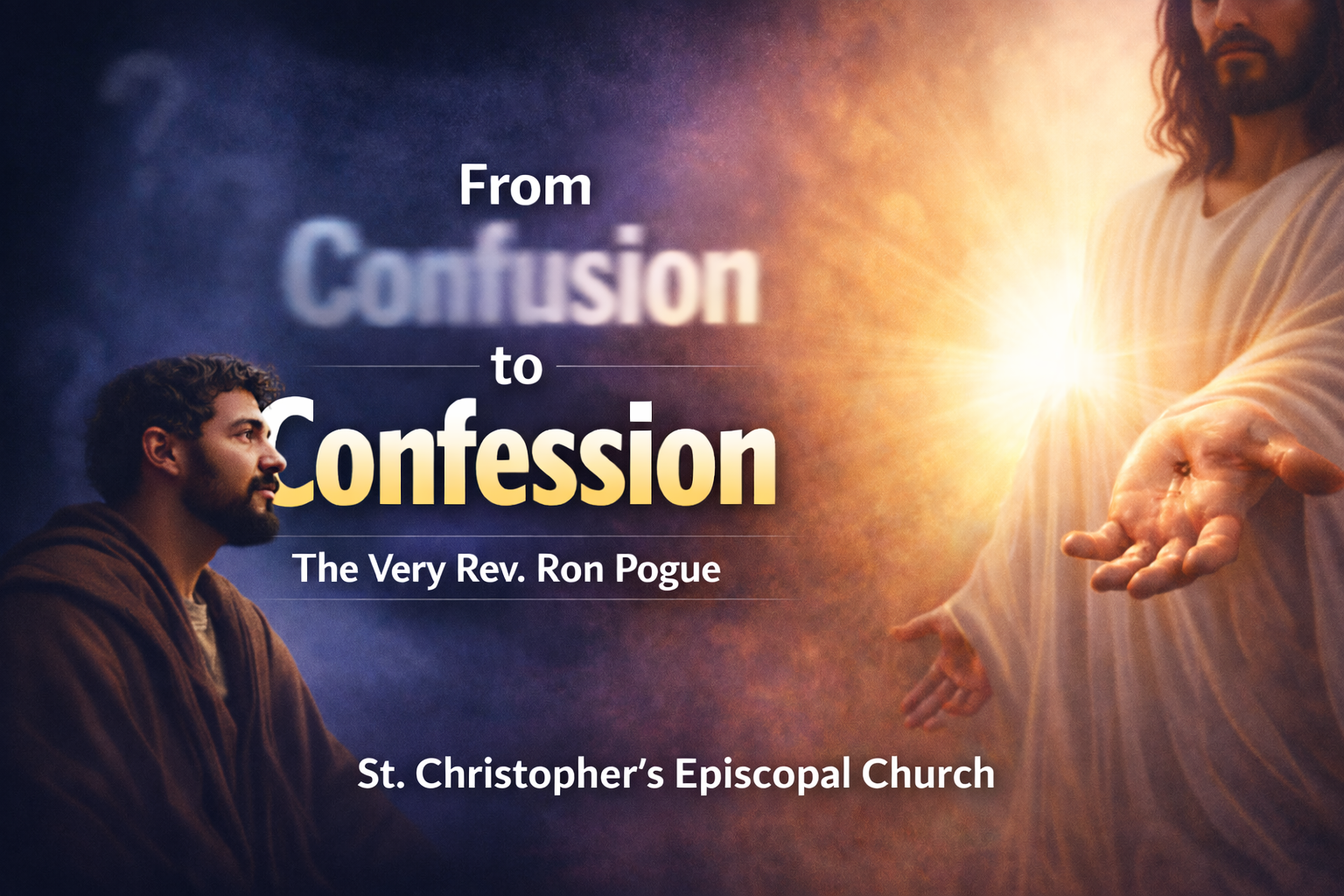
Once when a certain preacher launched into a children’s sermon, she was confronted by a visiting child, an eight-year-old friend of a regular member. The boy was new to this church but was a regular attendee at another congregation that did not have children’s sermons. Nevertheless, the visitor tried his best to follow the line of the preacher’s effort to connect with the children. Attempting to hook the children with something familiar before making her point, the priest asked the children to identify what she would describe. “What is fuzzy and has a long tail?” No response. “What has big teeth and climbs in trees?” Still no response. After she asked, “What jumps around a lot and gathers nuts and hides them?” the visiting boy could stand the silence no longer. He blurted out, “Look, lady, I know the answer is supposed to be ‘Jesus,’ but it sure sounds like a squirrel to me.” Today’s Gospel reveals to us St. Thomas – who was put in a situation similar to that of the boy at the children’s sermon. Thomas was the one who had not seen the risen Jesus when he first appeared to the disciples. The others told him they had seen the Lord, but he was skeptical. He doubted. Still, Thomas must have wanted to fit in. He might have said, “Look, friends, I know the answer is supposed to be that I acknowledge that you saw Jesus, but it sure sounds like a ghost to me.” Aren't we all a little like Thomas? Thank God for that! Because, as Elton Trueblood once said, “a faith that is never questioned isn't worth having.” Thomas remained with the others until his doubts and uncertainties were transformed into a dynamic faith. Doubt is a universal human experience. We have all felt the pain, the harassment, and the threat of it. Doubt comes in different depths. The deepest form denies that we can believe anything at all. The other extreme is the mind of the dogmatic that sails along with unquestioning confidence on a sea of tranquil certitude. While there is a certain appeal in dogmatic tranquility, there is also the danger that we might overlook the possibility of error in our most familiar beliefs. As much as we might like to think of eliminating any trace of doubt in our life, the truth is that it would be undesirable, even if it were possible. When someone tells me that he has never had a moment of probing religious doubt, I find myself wondering whether that person has ever known a moment of vital religious conviction. For if one fact stands out above all others in the history of religion, it is this: the price of a great faith is a great and continuous struggle to get it, to keep it, and to share it. Faith is a fight as well as a peace. I find myself thinking of my task as a Pastor and Teacher in the way described by Paul Tillich, when he said, “Sometimes I think my mission is to bring faith to the faithless and doubt to the faithful.” Tuesday of this week is the annual remembrance of the Holocaust, Yom Hashoah. As we recall that tragic chapter in human history, we are painfully reminded of Adolf Hitler. Hitler was an atheist. We usually think of atheism as ultimate doubt. But when you think of it as a religion, you can see how helpful it would be to have a system of doubt to correct it. Hitler had no religion to cast doubts on his approach to life. But there are other problems besides Hitler's form of atheism. There is, for example, practical atheism. Practical atheists believe in God. He just doesn't have anything to do with their lives. Martin Luther once wrote, “There is the person who has never doubted that God is, but who lives as though God were not; and there is the person who doubts whether God is, or even denies that God is, but lives as though God were. In the latter, the grace of God is at work.” Look at the lives of the saints. According to holy legend, doubt appears as a temptation which increases in power with the increase of saintliness. In those who rest on their unshakable faith, pharisaism, fundamentalism, and fanaticism are the unmistakable symptoms of doubt which has been repressed. Doubt is overcome not by repression but by courage. Courage does not deny that there is doubt, but it takes the doubt into itself as an expression of its own finitude and affirms the content of an ultimate concern – a concern that impacts our lives and how we relate to the world around us and the people in it. Courage does not need the safety of unquestionable conviction. It includes the risk without which no creative life is possible. The Christian faith is stronger than our doubts. It is like the Chinese proverb, which says, “Chinese sails, though full of holes, still work.” Suppose a half dozen of us were seated around the walls of a darkened room. We are told that somewhere in the open, middle space, there is a chair. It is not just any chair; it is an antique, the creation of a noted designer, worth several thousand dollars. Which of us will find that chair? Certainly not those who sit still and philosophize about where the chair might be placed, about its existence, or about its value. No, the chair can be found only by those who have the courage to get up and risk stumbling around in the dark, using whatever powers of reason and sensation we might have until the chair is discovered. Or in our relationships with those we love. I have faith that my wife loves me. I feel her kindness, her caring, her loving touch - all these I interpret to mean that she loves me. Not every moment of our relationship has been perfectly romantic. We went to high school together and during that time I thought she hated me. I was wrong; she was just shy. But I came to see that her acts of love are such that, while I cannot claim absolute certainty now or about the future, I have a deep faith in her love for me. We cannot ever “know” or “verify” the experience of love with the same probability as sunrise or a lab experiment, but we have faith that love is real, is what we know to be the case, is the explanation which correctly interprets certain “scientific” experience. Those who are familiar with the scientific method know that the point is not to set out to prove a theory but to attempt to disprove it. Doubt is an essential element in the advancement of science, in the pursuit of truth, and in critical thinking. As far as we know, human beings are the only creatures on the planet, perhaps in the cosmos, endowed with the privilege and responsibility to exercise reason. Once a young man said to the philosopher, Blaise Pascal, “Oh that I had your creed, then I would live your life.” Pascal replied, “let me tell you something, young man. If you will live my life, it will not be many days until you have my creed.” In other words, Pascal is saying it is easier to act your way into belief than the other way around. And when we see Thomas after the resurrection, we follow the trajectory of his faith from confusion to confession. The risen Christ, at last, confronted him in the presence of the others and together they dealt with his doubt until it gave way to affirmation. He does that for us, too. In an era when many people in power have a view of Christian faith that is very narrow and contained in a very confined context, I am grateful to be in a Church that has room for doubt and is open to questions. Those who come to us with those doubts and questions receive a genuine welcome and are lovingly embraced so that we can journey and grow together in faith, hope, and love. 
By Paula Jefferson April 6, 2026
By Paula Jefferson March 29, 2026
March 22, 2026
By Paula Jefferson March 16, 2026
Show More