
We have some wonderful readings today. The theme is calling…and following.


Usually, I begin sermons with a metaphor—a story that has a bit of humor and speaks to us about the Gospel reading.  But today that’s not necessary….because the story of Jonah (and the really big fish that swallowed up Jonah) is a metaphor for calling and following. 


The book of Jonah opens abruptly. Yahweh says one word to Jonah, “Up!” And then he tells Jonah to go to Nineveh, a huge city that has fallen into despicable ways. Jonah is supposed to proclaim to the whole city of Nineveh that their wickedness has provoked Yahweh—and now Nineveh will be destroyed. For the people of Nineveh, this was definitely not good news. 


Upon hearing God’s plan, Jonah did the logical thing. He ran away.


Jonah’s decision to run imperiled his life—and the lives of sailors with him on a boat. In the midst of a terrible storm, the sailors did the logical thing. They threw Jonah overboard. As soon as Jonah was off the boat, the storm stopped. 

Jonah, it turned out, was not a fantastic swimmer. He probably should have considered this before boarding a boat and going to sea.


But, God intervened. A great fish swallowed Jonah…and Jonah remained inside that great fish until he called out to Yahweh. 


Once Jonah was on dry land, God spoke again: “Up! Go to Nineveh and preach to it as I tell you.”


This time, Jonah does the illogical thing. He follows the calling and goes.


We will hear the Gospel of Mark throughout this year. It stands out among the four gospels: it’s the first one written, the shortest gospel, and the only one written before the Temple was destroyed. Mark’s worldview is distinct. We will hear a sense of urgency in his words—an implied inquiry, “Are you with Jesus? Or not?” 


The historical period between Jesus’ resurrection and the destruction of the Temple was turbulent. There was frustration with Roman oppression. And the Romans were frustrated with the zealots, religious laws unique to Judaism, and this new group of people following the Way. Jerusalem was a ticking time bomb…and time was running out.


So, whereas Jonah’s calling is an elaborate story with colorful characters and even a vomiting fish, Mark presents the calling of the first four disciples in one, brief paragraph.


In the few words Mark chose, he told us much about Jesus, about calling, and about following.


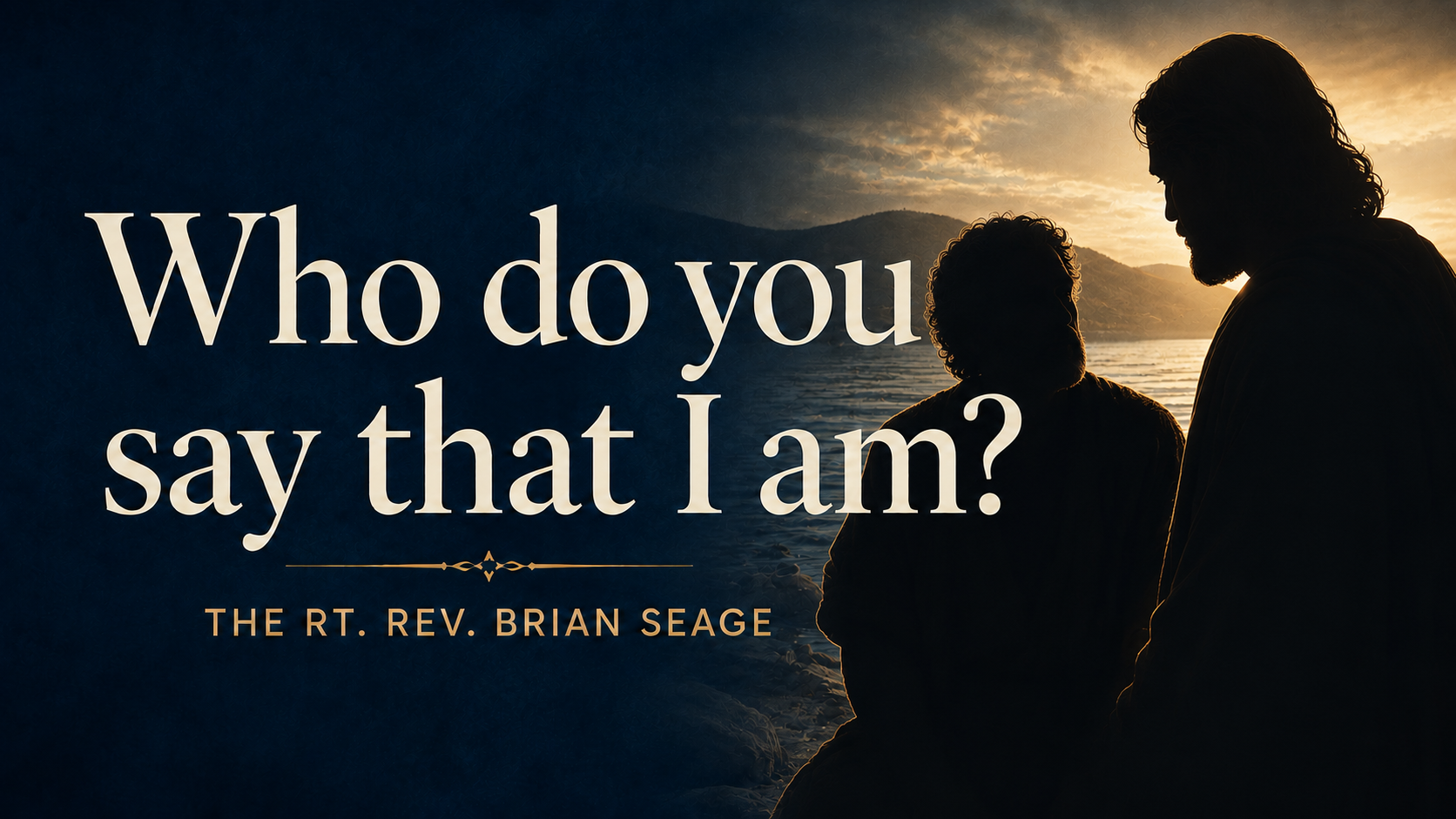
Mark sets the scene: Jesus is walking along the sea of Galilee…he sees Peter and Andrew fishing. He calls to them, “Follow me and I will make you fish for people.” Immediately, they abandon their nets and follow him. 


I’ve often wondered about this scene. ‘Fishing for people’ is unusual imagery. I wonder what it meant to Peter and Andrew? Did they know they were the first two fish in Jesus’ net? 

Next, Jesus sees James and John who were working in a boat with their dad. He called them, and they left their dad in the boat…and followed Jesus.


There is something compelling about Jesus that is not obvious from his spoken words.  But, it becomes obvious because of the response to his words.


He calls, “Follow me.”


Peter, Andrew, James, and John follow.


None of the disciples speak. They don’t ask questions. We would want to know things….”How long will we be gone? Will we be back in time for dinner? Do I need to pack a suitcase? Should I grab a charger for my cell phone? ....”


Unlike Jonah, the disciples do not run away. They do the illogical thing. They follow.


The subtext of this calling story is important. From the moment Jesus takes up his ministry, some people—not all—hear his voice through a lens of faith. They follow --- even though they are filled with unspoken and unanswered questions. 


They follow and the pilgrimage to resurrection begins. We are part of that pilgrimage, too.

Throughout the life of St. Christopher’s Episcopal Church, many people have walked this pilgrimage. None of us are here for all of it; all of us are here for some it. Our lives are changed by those we encounter as we go.


Along the way, Marshall Amis joined the pilgrimage of St. Chris. His impact in this congregation—and in the lives of those who knew him well—was meaningful and significant.


Early in our relationship, Marshall told me—emphatically--that he did not want to have a burial service when his time came. We disagreed on his reasoning and, therefore, we revisited the topic several times. Marshall died on the eve of his 96th birthday, December 30, 2023.


Today, we are celebrating his life in the midst of our Sunday worship—this is a compromise that meets his desire to not be overly recognized, and it is an opportunity for us to give thanks to God for the time we shared with Marshall.


Without Marshall, we would not be here in this physical place. 


At the beginning of his career as a civil engineer, Marshall was recruited by the City of Fort Worth to be its head of engineering.  A gentleman named Irwin Kraus imagined a new neighborhood in the southwest portion of Fort Worth. Mr. Kraus formed an entity called, “Wedgwood Enterprises.” He went to the city to obtain permission to proceed with his development. The City’s Engineer, Marshall Amis, turned him down.


Eventually, Mr. Kraus earned the necessary permits to move forward with his project. He was so impressed by Marshall during the negotiation with the city, that—after the deal was done--he hired Marshall away from the city.  Eventually, he made him a 50-50 partner in Wedgwood enterprises.

Together, they platted Wedgwood neighborhoods…including the property on which St. Matthew’s is built.  They named all those streets that begin with the letter W.  In fact, they named so many W streets, the fire department told them they had to stop. It was creating confusion in the emergency response system.


I visited Marshall many times over the past 18 months. We shared stories about our roots and he shared snippets from the Wall Street Journal. Marshall wasn’t one to speak emotionally. But it was clear to me that he cared deeply about this congregation…and this congregation cared about him. Twice, as I was leaving his facility, I encountered Ken Monroe coming to have lunch with Marshall. 


To follow Jesus is to see the world differently—through a lens of faith.  It is to know that our path leads to a new way of life, to resurrection, to life abundant in the eternal expanse of God’s love.


I am grateful for your witness of faithful pilgrimage.


May Marshall’s soul, and the souls of all the departed, through the mercy of God, rest in peace. Amen.


By Paula Jefferson July 26, 2026
By Melanie Kingsbury May 17, 2026
By Paula Jefferson May 10, 2026
By Paula Jefferson May 3, 2026
April 12, 2026
Once when a certain preacher launched into a children’s sermon, she was confronted by a visiting child, an eight-year-old friend of a regular member. The boy was new to this church but was a regular attendee at another congregation that did not have children’s sermons. Nevertheless, the visitor tried his best to follow the line of the preacher’s effort to connect with the children. Attempting to hook the children with something familiar before making her point, the priest asked the children to identify what she would describe. “What is fuzzy and has a long tail?” No response. “What has big teeth and climbs in trees?” Still no response. After she asked, “What jumps around a lot and gathers nuts and hides them?” the visiting boy could stand the silence no longer. He blurted out, “Look, lady, I know the answer is supposed to be ‘Jesus,’ but it sure sounds like a squirrel to me.” Today’s Gospel reveals to us St. Thomas – who was put in a situation similar to that of the boy at the children’s sermon. Thomas was the one who had not seen the risen Jesus when he first appeared to the disciples. The others told him they had seen the Lord, but he was skeptical. He doubted. Still, Thomas must have wanted to fit in. He might have said, “Look, friends, I know the answer is supposed to be that I acknowledge that you saw Jesus, but it sure sounds like a ghost to me.” Aren't we all a little like Thomas? Thank God for that! Because, as Elton Trueblood once said, “a faith that is never questioned isn't worth having.” Thomas remained with the others until his doubts and uncertainties were transformed into a dynamic faith. Doubt is a universal human experience. We have all felt the pain, the harassment, and the threat of it. Doubt comes in different depths. The deepest form denies that we can believe anything at all. The other extreme is the mind of the dogmatic that sails along with unquestioning confidence on a sea of tranquil certitude. While there is a certain appeal in dogmatic tranquility, there is also the danger that we might overlook the possibility of error in our most familiar beliefs. As much as we might like to think of eliminating any trace of doubt in our life, the truth is that it would be undesirable, even if it were possible. When someone tells me that he has never had a moment of probing religious doubt, I find myself wondering whether that person has ever known a moment of vital religious conviction. For if one fact stands out above all others in the history of religion, it is this: the price of a great faith is a great and continuous struggle to get it, to keep it, and to share it. Faith is a fight as well as a peace. I find myself thinking of my task as a Pastor and Teacher in the way described by Paul Tillich, when he said, “Sometimes I think my mission is to bring faith to the faithless and doubt to the faithful.” Tuesday of this week is the annual remembrance of the Holocaust, Yom Hashoah. As we recall that tragic chapter in human history, we are painfully reminded of Adolf Hitler. Hitler was an atheist. We usually think of atheism as ultimate doubt. But when you think of it as a religion, you can see how helpful it would be to have a system of doubt to correct it. Hitler had no religion to cast doubts on his approach to life. But there are other problems besides Hitler's form of atheism. There is, for example, practical atheism. Practical atheists believe in God. He just doesn't have anything to do with their lives. Martin Luther once wrote, “There is the person who has never doubted that God is, but who lives as though God were not; and there is the person who doubts whether God is, or even denies that God is, but lives as though God were. In the latter, the grace of God is at work.” Look at the lives of the saints. According to holy legend, doubt appears as a temptation which increases in power with the increase of saintliness. In those who rest on their unshakable faith, pharisaism, fundamentalism, and fanaticism are the unmistakable symptoms of doubt which has been repressed. Doubt is overcome not by repression but by courage. Courage does not deny that there is doubt, but it takes the doubt into itself as an expression of its own finitude and affirms the content of an ultimate concern – a concern that impacts our lives and how we relate to the world around us and the people in it. Courage does not need the safety of unquestionable conviction. It includes the risk without which no creative life is possible. The Christian faith is stronger than our doubts. It is like the Chinese proverb, which says, “Chinese sails, though full of holes, still work.” Suppose a half dozen of us were seated around the walls of a darkened room. We are told that somewhere in the open, middle space, there is a chair. It is not just any chair; it is an antique, the creation of a noted designer, worth several thousand dollars. Which of us will find that chair? Certainly not those who sit still and philosophize about where the chair might be placed, about its existence, or about its value. No, the chair can be found only by those who have the courage to get up and risk stumbling around in the dark, using whatever powers of reason and sensation we might have until the chair is discovered. Or in our relationships with those we love. I have faith that my wife loves me. I feel her kindness, her caring, her loving touch - all these I interpret to mean that she loves me. Not every moment of our relationship has been perfectly romantic. We went to high school together and during that time I thought she hated me. I was wrong; she was just shy. But I came to see that her acts of love are such that, while I cannot claim absolute certainty now or about the future, I have a deep faith in her love for me. We cannot ever “know” or “verify” the experience of love with the same probability as sunrise or a lab experiment, but we have faith that love is real, is what we know to be the case, is the explanation which correctly interprets certain “scientific” experience. Those who are familiar with the scientific method know that the point is not to set out to prove a theory but to attempt to disprove it. Doubt is an essential element in the advancement of science, in the pursuit of truth, and in critical thinking. As far as we know, human beings are the only creatures on the planet, perhaps in the cosmos, endowed with the privilege and responsibility to exercise reason. Once a young man said to the philosopher, Blaise Pascal, “Oh that I had your creed, then I would live your life.” Pascal replied, “let me tell you something, young man. If you will live my life, it will not be many days until you have my creed.” In other words, Pascal is saying it is easier to act your way into belief than the other way around. And when we see Thomas after the resurrection, we follow the trajectory of his faith from confusion to confession. The risen Christ, at last, confronted him in the presence of the others and together they dealt with his doubt until it gave way to affirmation. He does that for us, too. In an era when many people in power have a view of Christian faith that is very narrow and contained in a very confined context, I am grateful to be in a Church that has room for doubt and is open to questions. Those who come to us with those doubts and questions receive a genuine welcome and are lovingly embraced so that we can journey and grow together in faith, hope, and love. 
By Paula Jefferson April 6, 2026
By Paula Jefferson March 29, 2026
March 22, 2026
By Paula Jefferson March 16, 2026
Show More